TL;DR
Wooden ride-on toys are small wheeled toys toddlers sit on or push along with their feet. Choose one by checking your child’s fit and abilities, the maker’s age and weight guidance, and the toy’s construction; then use it on a clear, flat surface with supervision. Wood alone does not guarantee safety or sustainability, so check the finish, product information, and recall notices.
A wooden ride-on can look ready for a storybook: smooth wheels, a little painted car body, and a toddler pushing across the kitchen floor with a delighted squeak. But the prettiest toy on the shelf may be too tall, too heavy, or better suited to a larger play space. The right choice starts with your child, not the finish.

Turn the school run and nap time into listening time
- Thousands of audiobooks, podcasts and originals
- Listen on your phone, tablet or Echo — also offline
- Cancel anytime
This guide explains what wooden ride-on toys are, how to check fit and safety, and how to decide whether one works in your home. You’ll also find practical advice about surfaces, upkeep, and materials, plus a reminder to check applicable product requirements and CPSC recalls in the United States. A ride-on is a plaything, not a developmental treatment; for infant sleep, feeding, or medical questions, ask your pediatrician.
Treat the maker’s age label as a starting point; check fit, floor reach, climbing ability, and weight guidance.
Choose a clear, flat riding area away from stairs, roads, pools, and other hazards, and supervise young children.
Inspect the wood, finish, wheels, and fasteners before play; stop using a toy with damage until you have followed the maker’s advice.
Check CPSC recalls in the United States and applicable product safety information in your country.
Don’t assume wood guarantees safety or sustainability; check materials, coatings, sourcing details, and the toy’s condition over time.
What a Wooden Ride-On Lets Your Toddler Do
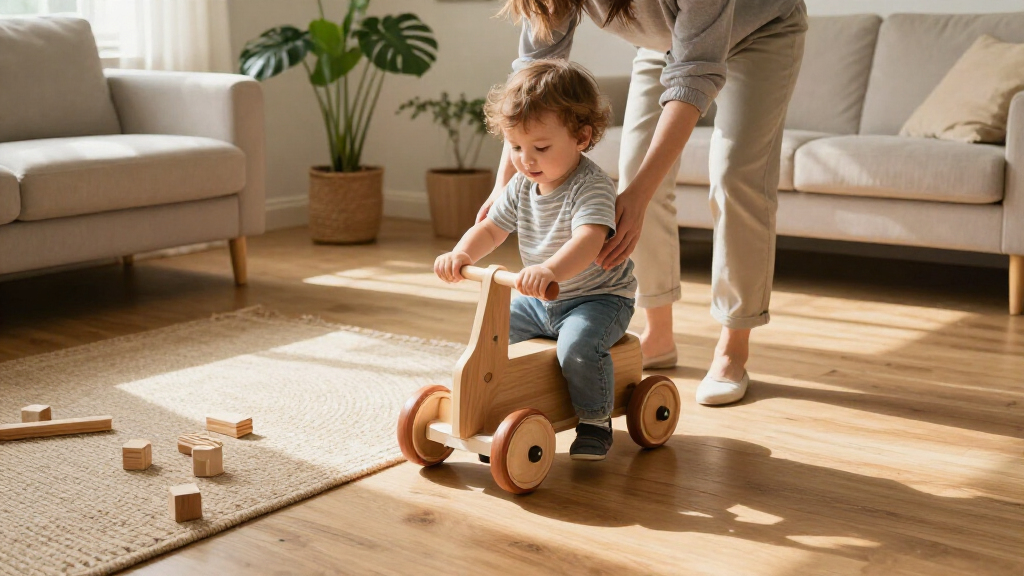
Wooden ride-on toys are small wheeled toys that toddlers sit on or push along with their feet. Common styles include little cars, wheeled animals, trucks, and balance-bike shapes, along with push toys a child steers while walking. The simple setup invites active, imaginative play: your toddler can “deliver” blocks from the rug to the sofa or give a stuffed bear a ride.
Riding and pushing give children chances to practice steering, balance, coordination, and using their legs. These skills involve different demands: pushing a toy while walking lets a child keep both feet on the floor, while sitting and scooting asks them to coordinate leg pushes with steering and stopping. A toy can offer opportunities to practice, but children develop at different rates, and the experience cannot promise a particular developmental result. Think of it as one more way to move and play, not a treatment or a substitute for guidance from a health professional.
For example, a confident toddler might scoot a wooden truck along a hallway, while a younger or less steady child may prefer pushing an animal toy with a handle. Some designs are meant to be sat on; others are for walking behind. Check which kind you’re buying, because the product’s shape and intended use affect both how your child interacts with it and what skills the toy asks them to manage. A seated toy may be frustrating if your child is not ready to balance on it, while a push toy may be less useful once they want to steer and propel themselves.
A ride-on works best when it invites play your child can manage comfortably, at their own pace.
Photos can make every model seem tiny and easy to steer. In person, a wide turning circle or heavy body can feel awkward in a narrow room. Product dimensions help you predict more than whether the toy will fit in storage: they hint at whether a child can turn around furniture, whether an adult can lift it out of the way, and whether play will be confined to one clear area. Picture the actual route through your home—around the coffee table, past the kitchen island, or over the threshold to the patio—before deciding.
Products Worth Considering

LEGO Technic PEUGEOT 9X8 24H Le Mans Hybrid Hypercar Building Set, 1:10 Scale

Graco TrueCoat 360 Drill-Powered Paint Sprayer

LEGO Icons Lamborghini Countach 5000 Quattrovalvole 10337 Building Set
As an affiliate, we earn on qualifying purchases.
Check Fit Before You Bring One Home
Choose a ride-on that matches your toddler’s size and abilities, and follow the maker’s minimum age, weight limit, and use guidance. When your child sits on the toy, they should be able to plant both feet securely on the floor. That contact gives them a practical way to start, slow down, and steady themselves; if they can only touch with their toes, controlling the toy may be harder. They should also manage getting on and off in a way that fits their current abilities.
Age labels help narrow the choices, but they don’t tell you everything about fit. They describe the maker’s intended age range, while children of the same age can differ in height, confidence, and coordination. A toy may fall within the age range and still be awkward for your child today. If you’re shopping in person, let your child sit on the toy with your close support and observe whether they can place both feet down and stay centered. If you’re buying online, compare seat height and overall dimensions with a toy they already use comfortably, while remembering that different shapes can feel different even at the same height.
Use this quick sequence before you decide:
- Read the product label for its minimum age, maximum weight, and instructions. These limits define how the maker expects the toy to be used; exceeding them can affect stability and durability.
- Check the seat and reach; your child needs to sit securely and put both feet down. A comfortable reach supports starting and stopping without relying on an adult to catch every wobble.
- Think about getting on and off; a seat that is too high can turn a fun ride into a frustrating climb. Repeatedly needing to be lifted on may also make independent play less practical.
- Match the toy to the play space; check the turning room, storage spot, and surfaces it can handle. A toy that fits your toddler but cannot turn safely in your home may spend more time parked than played with.
Imagine a two-year-old who can climb onto a low wheeled animal but struggles to reach the ground from a taller wooden bike-style seat. The bike might suit a later stage; the animal may fit today. That difference matters because a child who can start and stop with control can explore more confidently, while a poor fit may lead to repeated tipping, stretching, or requests for help. Choose for the abilities your child has now, while using the maker’s guidance to judge whether the toy remains appropriate as they grow.
Use a Short Safety Check Before Play
A wooden ride-on is ready for play when it is built as the maker directs, has stable construction and securely attached parts, and shows no cracks, splinters, sharp edges, or damaged finish. Wheels should roll predictably, and your child should use it on a flat, open surface away from stairs, roads, pools, fireplaces, and other hazards. Stay close, especially outdoors. Each check addresses a different risk: loose parts can change how the toy moves, damaged wood can expose sharp edges, and an uneven or crowded route can make stopping and steering less predictable.
Before the first ride, inspect the seat, handles, axles, and fasteners. Run your hand over the wood to spot rough patches, but don’t assume a smooth surface makes a toy safe on its own. Assembly matters because even a well-made toy can become unstable if a part is attached incorrectly or left loose. Follow the instructions rather than improvising repairs, and repeat a quick check when the toy has been stored, transported, or used heavily, since bumps and changing conditions can loosen parts over time.
For example, after a winter in a garage, a wooden truck could have a loose wheel or a scuffed patch where its finish has worn away. Put it aside until you have followed the manufacturer’s instructions for repair or confirmed it remains safe to use. A loose wheel can affect steering and stability, while damaged finish may expose the surface beneath it to further wear. A peeling finish or new splinter is a reason to stop play and contact the maker if you need product-specific guidance.
In the United States, check CPSC recall notices for the specific product or brand before purchase and during ownership. A toy that was acceptable when sold may later be subject to a recall, so checking the model helps you find instructions that apply to the exact product. Elsewhere, look up the safety requirements that apply in your country. If you’re buying secondhand, request the model name and instructions, and check whether it has missing parts, repair work, or an unresolved recall; without those details, it can be difficult to know whether a repair or safety notice applies.
Wood is a material choice, not a safety certificate. The product’s build, condition, instructions, and fit all matter.
Find a Surface That Suits Your Home
Indoor use works best on a flat, clear surface with room to steer and stop. Wooden wheels may sound louder on tile than on a rug, while some wheel materials may work more quietly or gently on hard floors. The tradeoff is that a surface that quiets the ride may also change how easily the toy rolls, so check the maker’s guidance and observe how the wheels behave. A ride-on designed for smooth indoor use may not handle rough paving outside, where bumps can interrupt its movement or make steering less predictable.
Think through a real trip: from the living-room rug to the hallway, the toy meets a raised threshold and clips the leg of a chair. A smaller turning radius and a cleared route could make that loop easier; pushing furniture aside may be more practical than buying a larger model. In a small apartment, the toy’s weight and storage footprint matter as much as its color. A bulky toy that is difficult to move can narrow walkways or make it harder to keep the play area clear, which may undermine the reason you bought it.
Outside, choose a level, open area and supervise closely. Keep rides well away from driveways, roads, water, and slopes. These boundaries reduce the chance that a child will roll into an area where they cannot stop safely or where an adult has less time to respond. Balance bikes and other faster or outdoor riding toys call for a helmet; follow the manufacturer’s directions and local guidance. A slow scoot inside is a different activity from building speed on a path, so match supervision and protective gear to the toy and setting.
Check wheel material, noise, turning radius, and storage needs before buying. If you rent or have delicate wood floors, ask the maker whether the wheels suit that surface and consider a play mat where appropriate. A mat can protect flooring, but it should lie flat and not create a raised edge that catches the wheels. A toy that stays easy to use—and easy to put away—is more likely to fit into ordinary family life.
Compare Wood, Finishes, and Long-Term Use
Wood can be durable and repairable, but “wooden” does not automatically mean safer or more sustainable than another material. Safety depends on the complete product, including its shape, construction, finish, and condition during use. Sustainability also depends on factors that a material label alone cannot show, such as sourcing, manufacturing, transport, and how long the toy remains useful. Check what the toy is made from, which coatings it uses, whether the finish is intended for children’s products, and what safety information the manufacturer provides. Avoid toys with peeling paint or damaged finishes.
A painted wooden car and a natural-finish balance bike can both have non-wood parts. Makers may use metal or plastic for wheels, axles, grips, or other features, each of which can affect weight, noise, upkeep, and how the toy moves on different surfaces. If a product listing calls a toy “eco-friendly,” look for specific details about wood sourcing, certification, manufacturing, finish, packaging, and expected lifespan instead of relying on a broad label. Those details help you judge what the claim means; without them, it is difficult to compare products or know whether a benefit applies to the toy as a whole.
| What to compare | What to check | Why it matters |
|---|---|---|
| Fit and use | Seat height, age guidance, weight limit | Your toddler needs to sit securely and reach the floor. |
| Materials | Wood type, wheels, axles, finish | The product may mix materials, and coatings can wear. |
| Care and lifespan | Repair instructions, replacement parts, condition | A toy that stays in good shape may serve siblings or another family. |
For instance, a family might pass a wooden ride-on from one sibling to another, but only if the wheels remain secure and the finish is intact. Before passing it on, inspect the parts that bear weight and take the maker’s repair guidance seriously: a repairable toy is useful only when it can be restored safely. Share its instructions and product details with the next caregiver so they can check fit, use it as intended, and look for relevant recalls. Longevity depends on how it is made and cared for, not just the fact that it is wood.
Make Everyday Play Easier to Maintain
A quick inspection and care routine can help a ride-on stay ready for ordinary play. Follow the maker’s cleaning and maintenance directions, and avoid assuming that every wood finish tolerates the same cleaners or moisture. A cleaner that is harmless on one coating may dull or damage another, while excess moisture can affect wood or leave parts damp. Check moving parts and surfaces regularly, especially after outdoor use or a bump against a wall, when dirt or impact may reveal a problem that was not obvious before.
Picture a little wooden car that has been pushed through cracker crumbs and patio dust. Start with the instructions: they may recommend a soft cloth for the body and a separate wipe for the wheels. This keeps cleaning simple while avoiding products or methods that could wear the finish. Let the toy dry as directed before putting it away, and don’t use a cleaning product unless the maker says it suits the finish.
- Before play: look for loose hardware, cracks, rough edges, and peeling finish. Catching these early lets you set the toy aside before a minor issue becomes a hazard.
- After outdoor play: remove dirt and check that wheels still turn as expected. Grit or debris can affect movement, so a quick check also tells you whether the toy needs cleaning before its next use.
- When damage appears: stop use and follow the maker’s repair or replacement advice. Continuing to use a damaged toy can make it harder to tell whether a problem is getting worse.
- When sharing or storing: keep instructions and product details with the toy. They help the next caregiver check how to use and maintain it.
Keeping the ride-on near a clear play area can make it easier to use and easier to supervise. If it is too heavy to carry up stairs or awkward to store behind a sofa, that friction may matter more than a small feature difference on a product page. Consider who will move it, where it can be stored without blocking a route, and whether it can be brought out without disrupting the room. Choose a model your family can manage on an ordinary Tuesday.
Frequently Asked Questions
What age can a toddler start using a wooden ride-on toy?
There isn’t one age that fits every child or model. Check the maker’s minimum age and guidance, then consider whether your toddler can sit securely, reach the floor, and get on and off with the support they need. For example, a low wheeled animal may suit a child who cannot comfortably use a taller seat.
How can I tell if the ride-on is the right size?
Look for a secure seated position with both feet planted firmly on the floor, and follow the product’s weight and age guidance. Compare the listed seat height with a ride-on your child already uses comfortably if you’re shopping online. A seat that forces a toddler to stretch for the ground can make starting and stopping harder.
Are wooden ride-on toys safe to use indoors?
They can be used indoors when the maker’s instructions allow it and you have a flat, open area away from hazards. Clear the route, supervise young children, and check how the wheels behave on your floors. If a toy scratches or makes too much noise, check its wheel guidance and consider another suitable surface.
Should my toddler wear a helmet?
For balance bikes and other faster or outdoor riding toys, a helmet is appropriate; follow the maker’s instructions and local guidance. Consider the toy and setting: a slow scoot on a clear indoor floor differs from riding outdoors on a path. Ask your pediatrician if you have questions specific to your child.
Are wooden ride-ons better than plastic ones?
Neither material alone tells you whether a toy is the better choice. Compare fit, construction, wheel behavior, finish, care instructions, weight, and how well the toy suits your home. A well-made toy in good condition that your toddler can use comfortably is a more useful measure than the material label by itself.
How do I know if a wooden ride-on has been recalled?
Look up the brand and model in the recall information for your country; in the United States, check CPSC recall notices. Ask for the model details and instructions if you’re buying secondhand. If you find a matching recall, follow the official notice and stop using the toy as directed.
Conclusion
Choose a ride-on your toddler can sit on securely, use as directed, and steer in the space you actually have. Check the construction and finish, read the maker’s instructions, and look up applicable recalls before the first ride.
Then make room for a small adventure: a wooden truck rattling softly past the sofa, a stuffed bear riding shotgun, and a clear path back to the toy box.