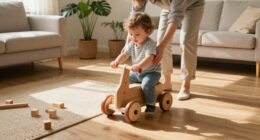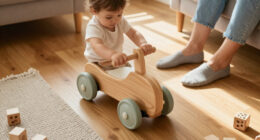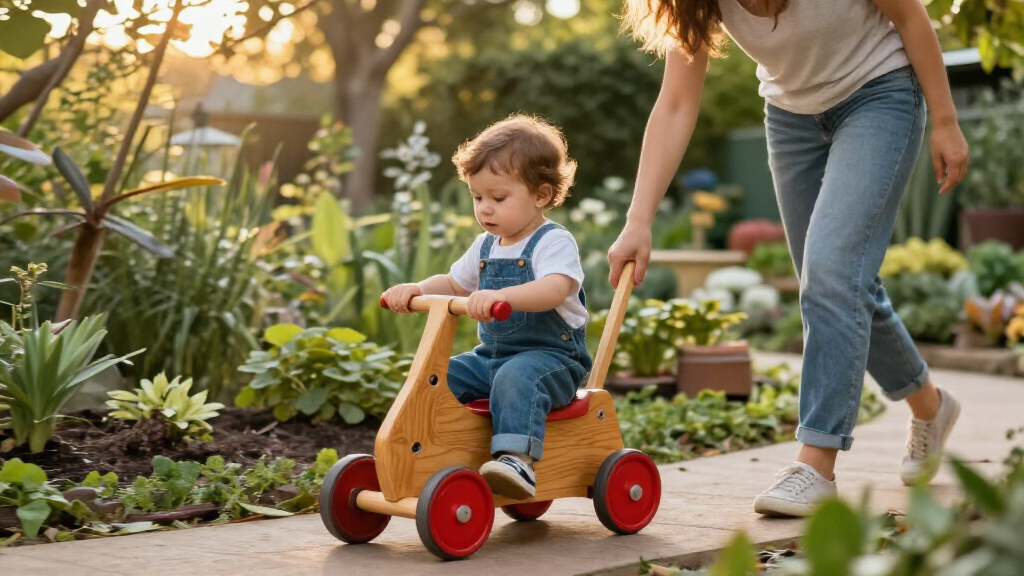
When shopping for a wooden ride-on toy, the real choice is often between a low, foot-powered push ride-on and a pedal ride-on styled like a small wooden vehicle. Both can give toddlers active play without batteries, but they ask different things of a child. A push ride-on is easier to start using: the child sits, keeps both feet on the ground, and moves by walking. A pedal ride-on adds a coordination challenge and may offer a longer period of use for a child who has the size and confidence to operate it.

Give the gift of listening to the whole family
- Choose a 1-, 3-, 6- or 12-month membership
- They pick the audiobooks they love
- Easy to send by email

Hape Scoot Around Wooden Ride-On Bike for Toddlers, Green
- ✔ Brand: Hape
- ✔ Model: E0101
- ✔ Age range: 12 months to 5 years

B. toys Zippity Zebra Wooden Ride-On Toy
- ✔ Brand: B. toys
- ✔ Type: Indoor push ride-on toy
- ✔ Materials: Fabric, metal, plastic, and wood
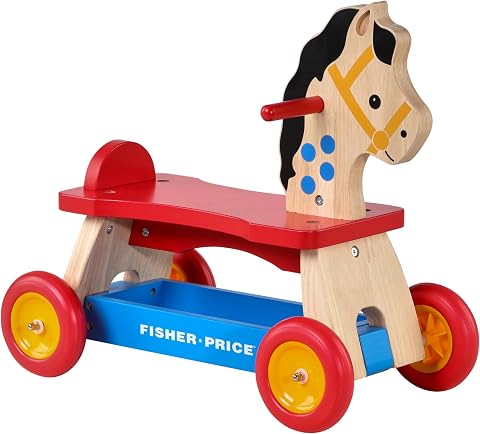
Fisher-Price Retro Wooden Pony Ride-On Toy
- ✔ Brand: Dynacraft
- ✔ Material: Wood
- ✔ Age range: 18 months to 3 years
For younger toddlers and families who want a simple indoor toy, the push model is usually the more practical fit. Pedal models make more sense when the child can reach the pedals, understands steering, and has a safe, open area to ride. The details vary by product, so check the maker’s age and weight limits, dimensions, materials, and safety guidance before buying. The comparisons below focus on the typical differences between these two types; a particular toy’s construction and design may change the result.
At a Glance
| Criteria | Wooden push ride-on toys | Wooden pedal ride-on toys | Winner |
|---|---|---|---|
| Ease of learning | Walks while seated; generally intuitive to try | Requires learning to pedal, steer, and coordinate | A |
| Age and size fit | Often suits younger toddlers, subject to product limits | Best only when the child fits the seat and reaches pedals comfortably | Depends |
| Movement and coordination | Builds balance, steering, and leg movement through walking | Adds pedaling coordination and sustained leg effort | B |
| Indoor maneuverability | Usually compact and simple to turn in small spaces | Needs room for turning and stopping | A |
| Play longevity | May be outgrown as the child wants more speed or challenge | Can remain engaging longer for a child who enjoys riding | B |
| Storage and footprint | Typically small, though shape and wheels vary | Often larger and less convenient to store | A |
| Typical value | Often a simpler, lower-cost starting point | May cost more; worthwhile when the added challenge gets regular use | Depends |
Hape Scoot Around Wooden Ride-On Bike for Toddlers, Green
For a toddler just starting to get around, four rubberized wheels make the Hape Scoot Around the clearest beginner-oriented choice in this group. Its listed age range begins at 12 months, earlier than the 18-month starting points for both the Zippity Zebra and Retro Wooden Pony. The broad four-wheel layout offers a different starting point from a more freely turning ride-on: it is designed as a push bike for practicing mobility, balance, and motor skills.Hape also specifies water-based paint and non-toxic finishes, while the rubberized wheels are intended to help protect floors. Those details may matter to families using the toy indoors. Compared with Zippity Zebra, Hape is less about a soft seat and rotating wheels; compared with the Pony, it does not list storage. Its main compromise is longevity: the product description cautions that a toy aimed at children beginning to develop mobility may become less useful as they grow. We would choose it for an early mobility stage, not as the obvious pick for a child already seeking more involved scooting.
Pros:
- Four rubberized wheels are intended to help protect indoor floors.
- Listed age range starts at 12 months.
- Water-based paint and non-toxic finishes are specified.
- Designed to support mobility, balance, and motor skills.
Cons:
- The beginner-oriented design may have limited usefulness as a child grows.
- No storage feature or soft seat is listed.
Best for: Families looking for a four-wheeled wooden ride-on for a toddler beginning to develop mobility, with an age recommendation starting at 12 months.
Not ideal for: Children who have moved beyond beginner mobility or families seeking under-seat storage, a soft seat, or a toy specified for more advanced scooting.
Bottom line: We’d start with the Hape Scoot Around when early mobility and rubberized four-wheel support matter more than storage or a soft seat.
“We’d start with the Hape Scoot Around when early mobility and rubberized four-wheel support matter more than storage or a soft seat.”
B. toys Zippity Zebra Wooden Ride-On Toy
The Zippity Zebra is the most characterful option in the lineup, but its practical distinction is the combination of a soft seat and 360-degree rotating wheels. That turning setup allows movement in any direction, giving it a freer indoor scooting style than Hape’s four-wheel beginner push bike. Families choosing between those two should consider the child’s stage and the room: Hape’s details emphasize early mobility and floor protection, while Zippity Zebra is positioned around active indoor movement.We also like that it arrives fully assembled, so there is no build step before play. Its sturdy handle and soft seat are useful comfort and control details, though the supplied specifications do not describe adjustable fit. The tradeoffs are clear: it is designed for indoor use, and its maximum capacity is 22.68 kg, lower than the Pony’s listed 40 lb limit. It starts at 18 months, so Hape is the more age-inclusive choice for younger beginners. Choose Zippity Zebra for its seat and maneuverability; skip it if outdoor use or a higher stated weight limit is central.
Pros:
- Soft seat and sturdy handle.
- 360-degree rotating wheels allow free movement.
- Arrives fully assembled.
- Supports active play and gross motor skill development.
Cons:
- Designed for indoor use.
- Maximum weight capacity is 22.68 kg.
- Stated age recommendation begins at 18 months.
Best for: Families with a child aged 18 months or older who want a ready-to-use indoor ride-on with a soft seat and freely turning wheels.
Not ideal for: Buyers wanting an outdoor ride-on, a higher listed weight capacity, or a stated age range beginning below 18 months.
Bottom line: We’d pick Zippity Zebra for comfortable, freely turning indoor scooting, provided its 22.68 kg limit fits the child’s needs.
“We’d pick Zippity Zebra for comfortable, freely turning indoor scooting, provided its 22.68 kg limit fits the child’s needs.”
Fisher-Price Retro Wooden Pony Ride-On Toy
The Retro Wooden Pony earns its spot with a feature neither rival lists: an under-seat storage box for small toys. That makes it a practical choice for families who want a ride-on that can also carry a few playroom essentials. Its vintage-style pony design and real wood construction give it a different feel from the animal-shaped zebra and Hape’s straightforward push-bike format. The wheels are described as indoor floor-friendly, and the rounded edges and non-toxic finishes are stated product details.Its listed 40 lb weight capacity is higher than Zippity Zebra’s 22.68 kg limit, though the two figures use different units. The Pony’s age range is 18 months to 3 years, narrower than Hape’s stated range, so we would check that fit carefully as a child grows. Compared with the Hape, it offers storage but starts later; compared with Zippity Zebra, it favors a pony shape and a storage compartment over 360-degree wheels and a soft seat. The design makes most sense when those specifics appeal, rather than when we need the broadest age window.
Pros:
- Under-seat storage holds small toys.
- Real wood construction with rounded edges and non-toxic finishes is specified.
- Indoor floor-friendly wheels are listed.
- 40 lb weight capacity is stated.
Cons:
- Stated age range is limited to 18 months through 3 years.
- The storage box is intended for small toys, not larger items.
- The supplied details do not specify 360-degree wheel movement or a soft seat.
Best for: Families with toddlers aged 18 months to 3 years who would use a small under-seat compartment and prefer a pony design.
Not ideal for: Families seeking a ride-on for a child younger than 18 months, a broader stated age range, or freely rotating wheels.
Bottom line: We’d choose the Retro Wooden Pony when a storage box and pony styling suit the child, while its narrow age window remains a key fit consideration.
“We’d choose the Retro Wooden Pony when a storage box and pony styling suit the child, while its narrow age window remains a key fit consideration.”
As an Amazon Associate we earn from qualifying purchases.
Key Differences
The central difference is how the child supplies movement. With a push ride-on, toddlers propel themselves by walking while seated, so they can put their feet down readily and move at a pace they control. That makes it a forgiving introduction to steering and riding. A pedal toy asks for a repeated pedal motion as well as steering and stopping. The extra task can be rewarding, but only if the child is physically ready and interested in learning it.
Space and fit matter as much as the riding mechanism. A small push toy is often easier to turn around furniture and store between play sessions. Pedal models need enough open area for movement and may take up more room. They can offer a longer-lasting challenge, which may justify a higher price for a child who uses it often. Still, age labels are only a starting point: compare seat height, pedal reach, weight limits, wheel design, and the maker’s safety instructions with the child and intended play area.
Detailed Comparison
Ease of learning (Wooden push ride-on toys wins — major)
Wooden push ride-ons win; the gap is major for a first ride-on. The child can move by walking and stop by placing feet on the floor, with steering introduced at a manageable pace. A pedal model requires learning to push pedals in sequence while keeping the toy pointed where intended. That can take practice and may frustrate a toddler who is not ready. Choose the simpler model when immediate, low-pressure play matters more than a new coordination task.
Age and size fit (major difference)
This depends on the individual child and product. Push models often serve as an earlier starting point, but the seat still needs to fit and the toy must meet its age and weight limits. Pedal ride-ons suit a child who can sit securely, reach the pedals, and understand basic steering. The gap is major if the child cannot reach the pedals; in that case the toy is impractical regardless of its stated age range. Check measurements and instructions rather than relying on age alone.
Movement and coordination (Wooden pedal ride-on toys wins — moderate)
Pedal ride-ons win for added coordination practice; the gap is moderate. Pedaling asks the child to repeat a purposeful leg motion while steering, adding a distinct skill to play. A push model still involves balance, movement, and steering, but the child’s feet remain available to propel or steady themselves. The more involved motion is useful only when it matches the child’s stage; it is not automatically better exercise or development for every toddler.
Indoor maneuverability (Wooden push ride-on toys wins — moderate)
Push ride-ons usually win; the gap is moderate. Their simpler movement and often compact form can make them easier to use in a playroom or hallway. Pedal models may need wider turns and more room to build momentum and stop. Actual maneuverability depends on wheel design, turning radius, and floor surface, so inspect the specific toy. In either case, clear the riding area and follow the maker’s use guidance.
Play longevity (Wooden pedal ride-on toys wins — moderate)
Pedal ride-ons often win; the gap is moderate. A child who masters a push toy may want more speed or a harder challenge, while learning to pedal can extend the novelty. That advantage depends on the child’s interest and whether the toy fits for long enough to use it. A pedal model bought too early can sit unused, and a well-loved push model can still earn plenty of play. Look for a realistic fit window, not just a promise of years of use.
Storage and footprint (Wooden push ride-on toys wins — moderate)
Push ride-ons usually win; the gap is minor to moderate. Many have a smaller footprint and are easier to tuck beside furniture or into a closet. Pedal designs can be longer or wider, especially when shaped like cars or trikes. Wooden toys are not necessarily light, so check the listed dimensions and weight if adults will move the toy often. Available storage space can make this a bigger factor in a small home.
Typical value (moderate difference)
Neither type wins for every household; the gap depends on use. Push models are often a lower-cost way to introduce riding, and they deliver good value when the child is young or play space is limited. Paying more for a pedal model is worthwhile when the child can operate it now, will use it regularly, and benefits from the added challenge. A higher price does not guarantee better fit or construction: compare materials, finish, wheel quality, warranty, and safety details on the exact products.
Wooden push ride-on toys: Pros and Cons
Pros:
- Intuitive movement for many first-time riders
- Child can propel and steady themselves with their feet
- Often easier to maneuver indoors
- Usually takes less storage space
Cons:
- Can feel too simple once the child wants a bigger challenge
- May have a shorter useful period as the child grows
- Still requires a suitable fit and clear riding area
Wooden pedal ride-on toys: Pros and Cons
Pros:
- Adds pedaling to the riding challenge
- Can hold interest longer for a child who enjoys learning to ride
- Offers a more involved riding experience
Cons:
- More difficult for a toddler to learn
- Pedal reach and coordination limit who can use it
- Often needs more room and storage space
Who Should Choose What
Choose Wooden push ride-on toys if:
- Your toddler is new to ride-on toys and needs a simple way to start
- You expect most play to happen indoors or in a compact room
- You want a lower-cost first toy and are comfortable with the possibility of outgrowing it sooner
Choose Wooden pedal ride-on toys if:
- Your child can comfortably reach the pedals and follow basic steering guidance
- They already enjoy riding and are ready to practice a more involved motion
- You have open, suitable space and expect frequent use that can justify paying more
Skip both if: Neither fits if the child falls outside the maker’s age or weight limits, cannot sit securely, or has no clear, suitable area to ride.
Value for Money
A push ride-on is usually the safer value bet when the child is young, the budget is limited, or you are unsure how much interest they will have in riding. It offers a straightforward play experience without charging extra for pedals the child may not be ready to use. Paying more for a wooden pedal ride-on makes sense when the fit is already right, the child wants to learn, and the toy will see regular use. The longer play window can balance the higher cost, but only if the child can use it now. Compare the specific toy’s dimensions, finish, wheel quality, weight limits, and warranty; price and wood construction alone do not establish durability or safety.
Final Verdict
For most families buying a toddler’s first wooden ride-on, choose a push model: it is easier to learn, generally simpler to use indoors, and often costs less. Choose a pedal model when your child demonstrably fits it, is interested in pedaling, and has room to ride. The biggest deciding factor is readiness: if the child cannot reach and work the pedals comfortably, the extra cost buys little. Check product-specific safety instructions and fit before either purchase.
Frequently Asked Questions
Are wooden pedal ride-ons harder for toddlers to use?
Usually. Pedaling adds a coordination step beyond sitting, walking, and steering. The difficulty varies by toy and child, so check whether the child reaches the pedals comfortably and follow the maker’s age guidance.
Which type is better for small indoor spaces?
A compact push ride-on is often easier to turn and store. Compare the exact dimensions and turning design, and keep the play area clear of furniture, stairs, and other hazards.
Is a more expensive pedal ride-on worth the extra cost?
It can be, if the child fits it now, wants to practice pedaling, and will use it often. If those conditions are not met, a simpler push toy is usually better value.
How should I choose the right size?
Use the manufacturer’s age and weight limits, then check seat height and pedal reach where applicable. The child should sit securely and operate the toy as directed; age ranges alone may not capture individual fit.