TL;DR

Turn the school run and nap time into listening time
- Thousands of audiobooks, podcasts and originals
- Listen on your phone, tablet or Echo — also offline
- Cancel anytime
Ride-on toddler toys let children move by pushing with their feet, rocking, pedaling, or using a motor; some include a handle for an adult to push. Match the toy to your child’s size and abilities, follow its instructions, supervise closely, and check for damage and CPSC recalls before use.
A toddler can turn a toy car into a delivery truck before you’ve finished your coffee. Ride-on toddler toys invite that kind of active, imaginative play, but the right pick depends on more than a bright color or a cute animal shape.
This guide explains how the main types move, what fit looks like, and which details matter for indoor and outdoor use. You’ll also get a practical checklist for supervised play and a reminder to check CPSC recall notices before buying or using a secondhand toy.
Choose by your child’s current size and abilities, not age label alone; check foot reach, posture, controls, and weight limits.
Foot-to-floor toys, balance bikes, pedal models, and battery-powered vehicles move differently, so compare how much control the child or adult provides.
Follow surface and use instructions, supervise within sight and reach, and use a properly fitted helmet when appropriate, especially for balance bikes.
Inspect wheels and moving parts, follow the maker’s cleaning and battery directions, and check CPSC recall notices in the United States before buying or using…
What ride-on toddler toys do during everyday play
Ride-on toddler toys are toys children sit on or straddle and move by pushing with their feet, rocking, pedaling, or using a motor; some let an adult push with a handle. The basic idea is simple: a child’s movement changes the toy’s speed or direction. For example, a toddler on a foot-powered car may push across the living room rug, then stop to steer around a chair.
Starting, stopping, and steering take different kinds of control. A foot-powered toy lets a child set the pace with each push, while a powered model can keep moving after the child presses a control. That difference affects how much space and adult attention a play area needs. On a small indoor floor, a child may have room to make short pushes but little room to recover from a fast turn.
These toys can give children a chance to practice coordinating movement with direction and judging the space around them. The experience depends on the child and the toy: a model that is easy to push may invite independent movement, while a rocking toy keeps play in a smaller area. A toy may also spark pretend play—a wooden animal becomes a parade float, while a plastic truck carries blocks down the hallway. These are opportunities for play, not guarantees of developmental milestones.
Age labels are a starting point, not a fit test. Check the manufacturer’s age and weight limits, and consider whether your child can sit or straddle as intended and reach the ground or controls without awkward stretching. A child who cannot plant their feet or reach the controls may be unable to stop or steer as intended, even if the age on the box seems right.
Compare 6 ride-on styles before you choose
Ride-on toddler toys differ most in how the child moves and how much control the adult needs to provide. A small wheeled toy powered by foot pushes suits a different kind of play than a battery-powered vehicle or an adult-pushed seat. More child control can make movement feel active and adjustable; motor power or an adult handle can shift more control away from the child. That changes which spaces are practical and how closely you need to manage movement.
| Type | How it moves | What to check |
|---|---|---|
| Foot-to-floor | Child pushes with feet | Secure sitting position and comfortable foot reach |
| Rocking ride-on | Child rocks while seated or straddling | Stable surface and supervised use |
| Balance bike | Child pushes, then coasts on two wheels | Fit, maker’s use guidance, and suitable protective gear |
| Pedal ride-on | Child turns pedals | Coordination and reach to pedals |
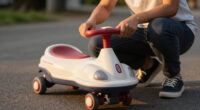
| Battery-powered | A motor propels the toy | Age and use limits, speed, battery, and charging instructions |
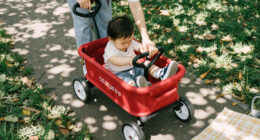
| Push ride-on | Adult pushes with a handle | Handle instructions and close adult control |
For example, foot-to-floor models let a child regulate movement through repeated pushes, so they can slow down by stopping their feet. A pedal model requires the child to coordinate pedaling with steering, which may make it less straightforward for a toddler who is still learning the controls. A motorized toy can travel under its own power, so its speed limits, stopping method, and permitted surface matter especially; a larger play area may be needed to keep turns and stops manageable.
A balance bike offers a different tradeoff: the child pushes and may coast, but the two-wheel frame requires balancing and space to move. A typical stable ride-on has a seat and four or more wheels. A push ride-on gives an adult more direct influence over movement, though the child still needs to sit as directed and the adult must keep control of the handle. The maker’s instructions help you judge whether a particular model suits your child.
Check the fit with these 5 simple steps
To choose a ride-on that fits, compare your child’s size and abilities with the manufacturer’s guidance, then check whether they can use the toy as intended. Fit affects control: if a child has to stretch for the floor, pedals, or steering, they may struggle to start, turn, or stop. This matters more than picking a model based on a birthday age alone. A toy that looks roomy in a photo may leave a child’s feet dangling in person.
- Read the age and weight limits. Treat both as product-specific instructions, not broad promises about what every toddler can do. The weight limit describes a boundary for the toy; the age guidance does not guarantee that a child has the skills to operate it.
- Check the seat or frame height. Your child should sit or straddle the toy as the maker describes. A posture that feels cramped or unstable can make it harder to turn or stay seated.
- Look at foot reach and controls. Consider whether your child can reach the floor, pedals, steering, or other controls without straining. Foot reach matters because it may help a child control speed on foot-powered models; on powered models, check that the child can reach and understand the controls.
- Match the toy to their current ability. If they cannot manage the intended posture or controls, choose a different model or wait. A toy with more features or power may offer more kinds of play, but also asks the child to manage more controls.
- Read use and care instructions. Check where the toy can go, how to assemble it, and how to inspect or clean it. A model suitable for one surface may not behave the same way on another.
Imagine trying a foot-powered toy in a clear, flat area: your toddler can settle into the seat, place their feet down, and make short pushes without reaching far. Watch whether they can slow or stop comfortably, as well as move forward. That practical check gives you more useful information than a label or a themed design alone.
Set up safer play indoors and outside
Safer ride-on play starts with adult supervision, a suitable surface, and the product instructions. Toddlers may not recognize a hazard or reliably stop and steer, so keep your child within sight and reach. Close supervision matters because small changes—a faster push, a turn toward a doorway, or another person entering the area—can leave little time to intervene. A hallway can feel like a racetrack to a small child, but stairs, doorways, other people, and furniture change what’s safe for that space.
- Use the toy only on surfaces allowed by its instructions; rough, wet, sloped, or uneven ground can affect steering and stability. The same toy can roll or turn differently as the surface changes, so a familiar route is not automatically suitable in every condition.
- Keep away from roads, stairs, pools, and steep slopes unless the product specifically permits the surface. These areas leave less room or time for a toddler to stop and for an adult to respond.
- Use protective gear when appropriate. A properly fitted helmet is especially important for a balance bike or another toy that can gain speed; follow the maker’s guidance and local advice.
- Check wheels, steering, fasteners, brakes, and moving parts before play. A loose or worn part may affect how the toy moves, so stop using it if something is loose, damaged, or worn.
- For powered models, follow battery and charging directions, including any limits on speed and use. Their ability to move without repeated foot pushes makes the stopping method and the space around the child particularly important.
Indoor use depends on the room and the toy. A slow model designed for indoor floors may work in a clear play area, but tight turns beside a glass coffee table call for a different setup. The floor’s grip, available space, nearby furniture, and other people all matter. If there is not enough clear space to turn and stop, choose another area or another activity.
Keep the toy matched to the place: a clear, level play area gives your toddler room to move and gives you room to stay close.
Buy smarter by checking the details beyond the design
A ride-on toy’s everyday fit matters as much as its appearance. Before buying, check where it will live, what surface your family has, and how you’ll store and clean it. These practical limits affect whether a toy can be used as intended: a large battery-powered vehicle might look exciting in a product photo but be awkward to charge and store in a small apartment. A simpler model may be easier to bring out and put away, even if it offers fewer features.
Before you buy, look for the manufacturer’s warnings, age and weight guidance, and information about applicable safety standards where the toy is sold. Those details help you compare a specific product with your child and intended play area rather than relying on appearance or broad marketing claims. Check the U.S. Consumer Product Safety Commission (CPSC) recall database for recall notices if you are in the United States, and consult the relevant regulator in your country. For a secondhand toy, look closely for missing parts, cracks, loose fasteners, damaged wheels, and missing instructions; missing instructions can make assembly and ongoing checks harder to assess.
Recent designs include balance bikes in toddler sizes, parent push handles, convertible modes, quieter wheels, and battery models with adjustable speed or sound effects. Each feature has a practical tradeoff: convertible modes may save storage space but add steps to set up, while quieter wheels may suit indoor floors but do not make a cramped area safer. Adjustable speed can give caregivers more choice, but it does not remove the need to follow use limits and supervise. These are product features, not proof that a toy is safer or more durable. If a listing describes materials as recyclable or sustainably sourced, check the maker’s specifications rather than treating the claim as a measure of play quality.
Make the practical check before paying: does the toy suit your child now, fit the intended space, and come with clear instructions? A compact foot-powered model may be easier to clean and store than a larger one with lights and sounds, even if both catch your toddler’s eye. Think about the tradeoff between features you will use and the space, setup, and care they require.
Keep the routine simple after the first ride
After choosing a toy, make a quick pre-play check part of the routine: look for loose or damaged parts, choose a suitable area, and stay close. That small habit helps you spot a problem before the first push and confirms the play area still suits the toy that day. For a battery-powered model, include the battery and charging condition in your checks.
Follow the model’s cleaning and maintenance directions rather than assuming every toy can take the same treatment. A dusty outdoor ride-on may need a different clean from an indoor model with electronic sounds. If wheels wear down or steering changes, stop use and consult the manufacturer’s instructions; a toy that no longer rolls or turns as expected may be harder for a child to control.
Some families find that a ride-on becomes part of a daily loop: a few supervised pushes in the yard, then the toy rolls back to its storage spot. That simple pattern makes it easier to notice how the toy behaves and whether it still fits your child’s abilities. It also keeps the toy available without leaving it in a walkway where someone might trip over it.
Frequently Asked Questions
What age can a toddler start using a ride-on toy?
There is no single age that fits every child or every model. Check the maker’s minimum age and size guidance, then see whether your child can sit or straddle the toy with stable posture and appropriate foot reach.
Are ride-on toys safe to use indoors?
Some models are designed for indoor use, but safety depends on the toy, the floor, the available space, and nearby hazards. Follow the instructions, clear the play area, and supervise closely.
Does my child need a helmet for a ride-on toy?
Helmet guidance depends on the toy, how it is used, and local recommendations. A properly fitted helmet is especially important for a balance bike or another toy that can gain speed; check the maker’s instructions.
What is the difference between a ride-on toy and a balance bike?
A typical ride-on toy has a seat and four or more wheels for stable play. A balance bike is a two-wheel cycle without pedals that a child straddles, pushes with their feet, and may coast on.
What should I check before buying a secondhand ride-on?
Check the age and weight guidance, instructions, required parts, wheels, steering, fasteners, and any signs of damage. Search the CPSC recall database in the United States, or the relevant product-safety regulator in your country.
Conclusion
Choose a ride-on your toddler can use as intended, then pair it with a clear play area, close supervision, and regular checks. The best ride can be a simple foot-powered toy: small pushes, a wide grin, and a safe place to go.
Halloween Picks
halloween
As an affiliate, we earn on qualifying purchases.