Counting parking spaces during pretend play helps you teach children early STEM skills like measurement, spatial awareness, and planning. As they organize toy cars and mark spaces, they learn to estimate dimensions, understand space management, and consider safety—all key ideas in urban planning. This type of play mirrors real-world challenges and benefits community development. Keep exploring to discover how these activities foster important skills and connect to broader safety and design principles.

Turn the school run and nap time into listening time
- Thousands of audiobooks, podcasts and originals
- Listen on your phone, tablet or Echo — also offline
- Cancel anytime
Key Takeaways
- Pretend play with toy cars teaches children spatial awareness and basic counting skills crucial for STEM learning.
- Organizing parking spaces in play mimics real-world urban planning, highlighting measurement and space management.
- Counting parking spots enhances numeracy skills, fostering early understanding of numbers and quantities.
- Simulating parking lot layouts introduces safety considerations and design principles fundamental to urban planning.
- Play-based learning with parking setups demonstrates practical applications of STEM concepts like measurement and spatial reasoning.
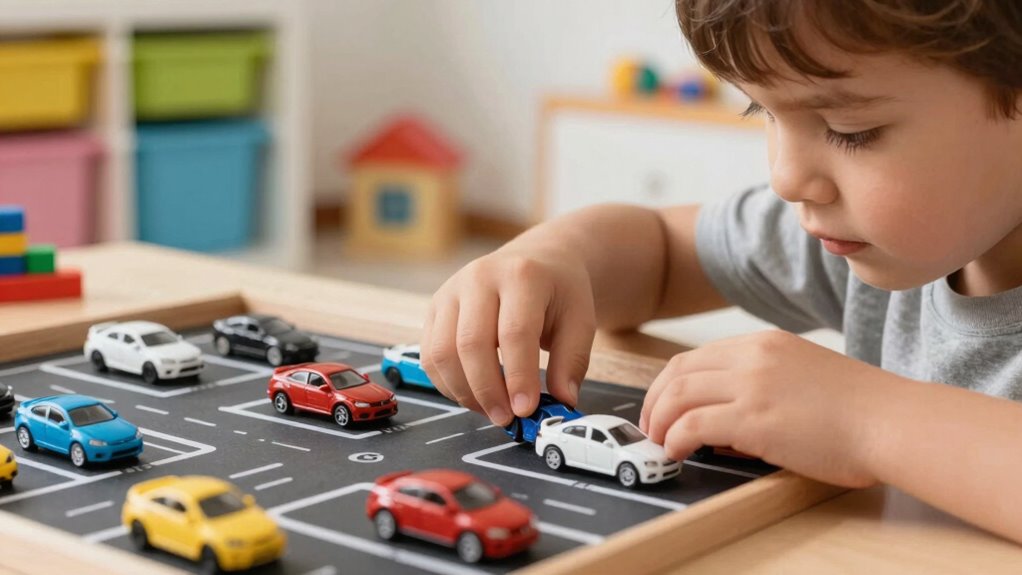
Have you ever wondered how parking lots determine the number of spaces they can hold? It’s a question that might seem simple at first, but behind the scenes, it involves a mix of urban planning and careful attention to parking safety. When designing a parking lot, planners don’t just guess the number of spots needed; they use precise measurements and calculations to maximize space while ensuring safety for pedestrians and vehicles alike. This process is an essential part of urban planning because it balances the needs of drivers with the safety of everyone on and around the property.
Designing parking lots involves precise measurements and safety considerations to maximize space and protect pedestrians.
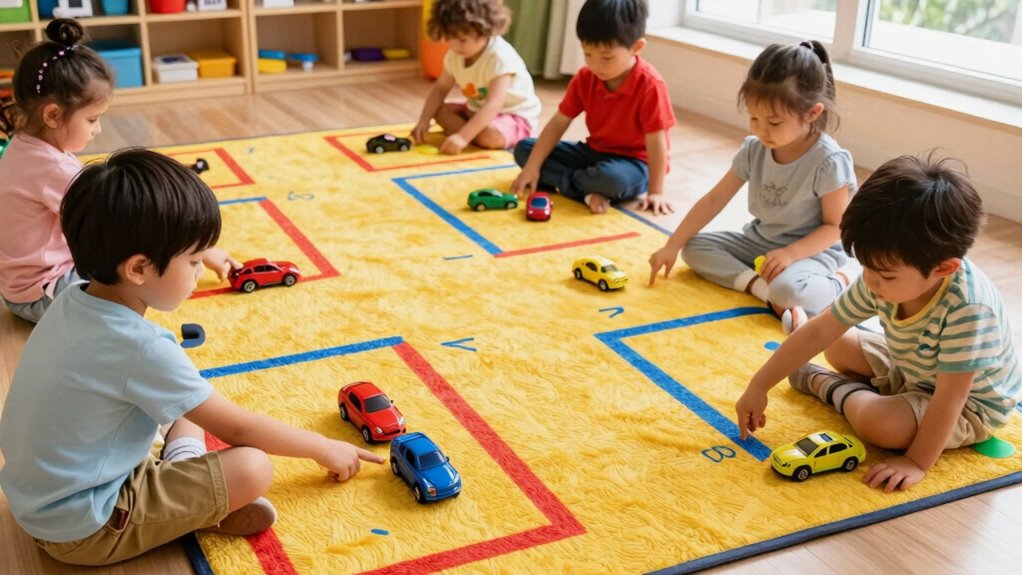
In pretend play, children often mimic real-world activities, and counting parking spaces becomes a fun way to understand these concepts. When kids set up a pretend parking lot, they learn about spatial awareness and how to organize space efficiently. They might use toy cars and small markers to create parking spots, which helps develop their sense of measurement and number sense. This playful activity introduces them to the idea that space isn’t unlimited, and planning is necessary to fit everything in safely and effectively.
By engaging in this kind of pretend play, children also start to grasp the importance of urban planning. They see that cities and towns need to think carefully about where to place parking lots, how many spaces are enough, and how to keep the area safe for everyone. For example, they might decide to leave enough room for pedestrians to walk safely, which mirrors real-world priorities around parking safety. These lessons aren’t just about counting spaces but about understanding how to create functional, safe environments that serve the community’s needs.
As you observe children’s pretend play involving parking lots, you realize that this activity subtly introduces complex ideas about space management and safety. They learn that too many cars can cause congestion, but too few can inconvenience visitors. They also see that proper planning involves clear markings, enough space for turning, and safe walkways—principles that are crucial in real urban planning. When children play, they’re practicing problem-solving skills, visualizing how space is used, and developing an understanding of safety measures. All of these lessons form a foundation that can influence how they view the importance of organized, well-thought-out urban environments when they grow up. Additionally, understanding the measurement techniques used in urban planning can help children appreciate the precise calculations involved in designing efficient spaces, especially as technology like GIS continues to improve planning accuracy. Recognizing the role of technology in modern urban planning highlights how advancements in tools like GIS and automated measurements contribute to more accurate and safe designs.
In essence, counting parking spaces in pretend play is more than a simple game. It’s a subtle but powerful way to introduce children to the STEM principles behind urban planning and parking safety. It helps them see that behind every well-designed parking lot lies careful calculation and a concern for everyone’s safety—lessons that can shape their understanding of the built environment and inspire future innovations. Understanding urban planning as a discipline can foster an appreciation for how cities grow and adapt to meet community needs.
As an affiliate, we earn on qualifying purchases.
Frequently Asked Questions
How Does Pretend Play Improve Children’s Problem-Solving Skills?
You can see pretend play boost your child’s problem-solving skills by encouraging them to design parking lots, considering parking space counts and layout, which involves parking lot design. They also practice vehicle categorization, sorting different toy cars by size or type. This imaginative activity helps them develop critical thinking, plan ahead, and adapt strategies, all essential skills for solving real-world problems. It makes learning both fun and effective.
What Age Is Best for Introducing Parking Lot Pretend Play?
You should introduce parking lot pretend play around ages 3 to 5, when children start grasping basic organization skills. During this stage, they can learn parking lot organization by arranging spaces and practice vehicle categorization by types or sizes. This activity encourages problem-solving, enhances fine motor skills, and fosters social interaction. Keep the play simple and fun, adapting to your child’s developmental level for the best learning experience.
How Can Parents Encourage STEM Learning Through Pretend Parking Games?
Think of pretend parking as building a mini city where your child becomes an urban planner. You can encourage STEM learning by guiding them through parking lot design, where they plan spaces and routes, fostering spatial skills. Incorporate vehicle identification to make it more engaging, asking them to identify different vehicles and assign parking spots. These activities develop problem-solving, critical thinking, and foundational math skills while making pretend play exciting and educational.
Are There Safety Concerns With Toy Parking Lots?
Yes, there are safety concerns with toy parking lots. You should check toy safety labels to guarantee they’re free from small parts that could pose choking hazards. Also, watch out for play area hazards like sharp edges or loose parts that might cause injuries. Always supervise your child during play, and choose sturdy, non-toxic toys to reduce risks and make playtime both fun and safe.
How Does Counting Parking Spaces Support Early Math Development?
Counting parking spaces helps you support early math development by enhancing number recognition and spatial awareness. When children count each space, they learn to identify numbers and understand their order. Moving around the parking lot, they develop spatial skills by steering through and estimating distances. This playful activity makes math concepts tangible, engaging kids in problem-solving and critical thinking while building a strong foundation for future learning.
Conclusion
As you guide your little one through counting parking spaces, you’re planting seeds of curiosity that bloom into confidence. Each number becomes a stepping stone across a river of pretend play, turning everyday moments into magical adventures. With every count, you’re not just filling a parking lot—you’re building a bridge to future learning. So, keep the game going, and watch as their love for numbers grows like a garden in full bloom.
Cold & flu season Picks
humidifiers
As an affiliate, we earn on qualifying purchases.