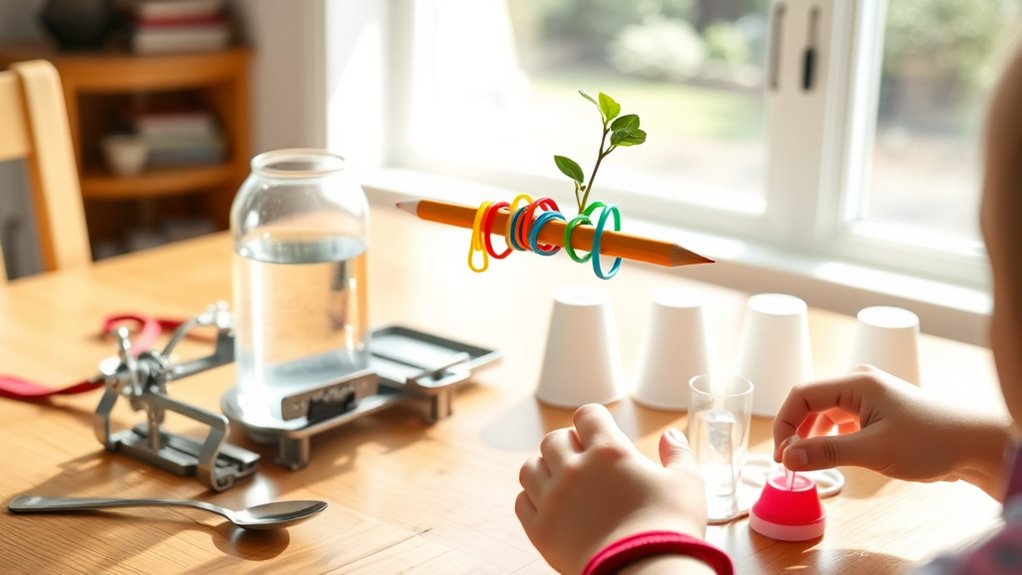

You can easily create fun STEM activities at home using common household items like paper, tape, and plastic bottles. Build simple structures such as bridges or water filters, or explore chemical reactions with baking soda and vinegar. You can also plant seeds or experiment with everyday materials to learn about physics and biology. These hands-on projects boost curiosity and critical thinking, showing how science is part of daily life. Keep exploring to discover more exciting ways to inspire young explorers.
Key Takeaways
- Use household items like paper, tape, and bottles to build structures, encouraging engineering and design skills.
- Conduct chemical reactions such as baking soda and vinegar eruptions to explore basic chemistry concepts.
- Create simple water filters with everyday materials to teach about porosity and environmental science.
- Plant seeds in recycled containers to observe plant growth and learn about biology and the scientific method.
- Incorporate everyday activities, like baking or measuring, to teach math, ratios, and measurement skills through hands-on experiments.

Are you looking for easy ways to introduce STEM concepts to kids? You don’t need fancy toys or complicated kits to spark curiosity and foster learning. Simple STEM activities at home can be incredibly effective, especially when you focus on hands-on experiments using everyday materials. These activities help kids see science, technology, engineering, and math as fun, approachable, and relevant to their daily lives.
Start with basic hands-on experiments that use common household items. For example, you can explore physics by building a simple paper bridge with newspaper and tape. Challenge your child to create a structure that can hold small weights, encouraging them to think about balance, strength, and engineering principles. You’ll be surprised how much they learn about structural integrity just by experimenting with what’s available around the house. Similarly, you can teach about chemical reactions with a baking soda and vinegar volcano. This classic experiment demonstrates gas production and reaction rates using only vinegar, baking soda, and a container—materials you probably already have in your kitchen. Watching the fizz and eruption helps kids understand basic chemical reactions firsthand.
Another engaging activity involves using everyday materials to explore patterns and measurements. For instance, you can create a simple water filter using a plastic bottle, coffee filters, and gravel or sand. This introduces concepts of filtration, porosity, and environmental engineering. Kids love seeing how different materials affect water flow and clarity, which makes abstract ideas more concrete. For math, you can turn baking or cooking into a lesson by measuring ingredients, calculating ratios, or even creating simple graphs of ingredients versus quantities. This turns a routine task into a fun, educational experience that highlights the importance of math in everyday life.
You can also explore the natural world with activities like planting seeds in recycled containers and observing growth over time. This teaches biology and the scientific method—hypothesize, observe, record, and analyze. All you need are some seeds, soil, and containers you already have at home. It’s a great way to introduce scientific inquiry and patience, plus it shows how science is part of nurturing life. Additionally, understanding the fundamentals of career and professional development can help kids see the connection between their activities and future opportunities in STEM fields.
The best part about these simple STEM activities is that they’re accessible, inexpensive, and adaptable to any age. Kids learn best when they’re actively involved, experimenting with what’s around them, and asking questions. By incorporating hands-on experiments with everyday materials, you turn learning into a fun, meaningful adventure that naturally sparks curiosity and builds foundational STEM skills.
Frequently Asked Questions
How Can I Adapt STEM Activities for Different Age Groups?
When adapting STEM activities for different age groups, you focus on age-appropriate modifications and engagement strategies. Younger kids benefit from hands-on, visual tasks, while older children enjoy more complex challenges that encourage critical thinking. You can simplify instructions for younger kids and add layers of complexity for older ones. By tailoring the activities to their developmental levels and interests, you keep everyone engaged and learning effectively.
What Safety Precautions Should I Take During Home Experiments?
While curiosity fuels discovery, safety remains your guiding star during home experiments. Always wear proper safety gear, like goggles and gloves, to protect yourself. Keep a watchful eye, especially with younger explorers, and follow supervision tips to prevent accidents. Clear your workspace of hazards, and never mix chemicals without understanding their risks. Remember, safety isn’t a barrier but a bridge to fun, safe learning adventures that inspire confidence and exploration.
How Can I Encourage Creative Problem-Solving in STEM Activities?
To encourage creative problem-solving in STEM activities, you should promote creative thinking by asking open-ended questions and encouraging experimentation. Support innovation skills by letting you try different approaches without fear of failure. You can also provide diverse materials and challenge you to develop unique solutions. This hands-on, exploratory environment helps you build confidence, sparks curiosity, and nurtures your ability to think outside the box while solving problems creatively.
Are There Any Budget-Friendly Materials Recommended for These Activities?
For budget-friendly STEM activities, you can use low-cost supplies like tape, paper clips, and rubber bands. Recyclable materials such as cardboard boxes, plastic bottles, and paper towel rolls are also great options. These items are easy to find around your home and help you create engaging projects without spending much. By using low-cost supplies and recyclable materials, you’ll encourage creativity and problem-solving while staying within your budget.
How Do I Assess My Child’s Learning Progress Through These Activities?
You might think assessment methods are complicated, but tracking your child’s progress can be simple and fun. Observe their problem-solving skills, ask them to explain concepts, and note how they handle challenges. Keep a journal or take photos to document their growth. Regularly engaging in these activities helps you see their understanding develop, making progress tracking both effective and enjoyable without the need for formal tests.
Conclusion
Just like building a sturdy bridge with everyday materials, these simple STEM activities lay the foundation for curiosity and problem-solving. I watched my child turn a paper towel roll into a mini rocket, igniting her passion for science. Remember, you don’t need fancy toys—just your enthusiasm and a few household items. With each experiment, you’re helping your little engineer discover that the greatest tools are often right at home, waiting to be explored.