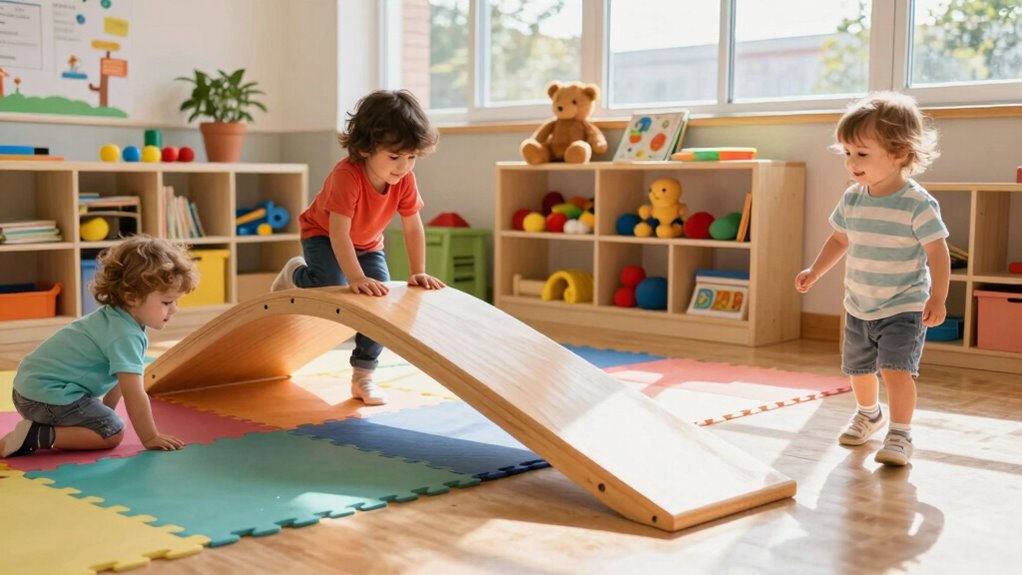

Setting up simple ramp activities in preschool spaces helps children explore basic science concepts like gravity, motion, and stability through hands-on play. You can encourage them to roll balls or push toy cars down different ramps, showing how angles and surfaces affect speed and movement. These activities promote curiosity, problem-solving, and teamwork, creating a lively environment for discovery. If you keep exploring, you’ll find more ways to make science fun and engaging for young learners.

Turn the school run and nap time into listening time
- Thousands of audiobooks, podcasts and originals
- Listen on your phone, tablet or Echo — also offline
- Cancel anytime
Key Takeaways
- Ramps introduce basic physics concepts like gravity, motion, and speed through hands-on activities suitable for preschoolers.
- Designing and testing ramps develop early engineering skills, including problem-solving and understanding stability.
- Using various ramp types makes abstract ideas accessible and engaging for young children.
- Collaborative building and testing promote social skills and teamwork among preschoolers.
- Ramps create a dynamic, playful environment that encourages curiosity and active exploration of science concepts.
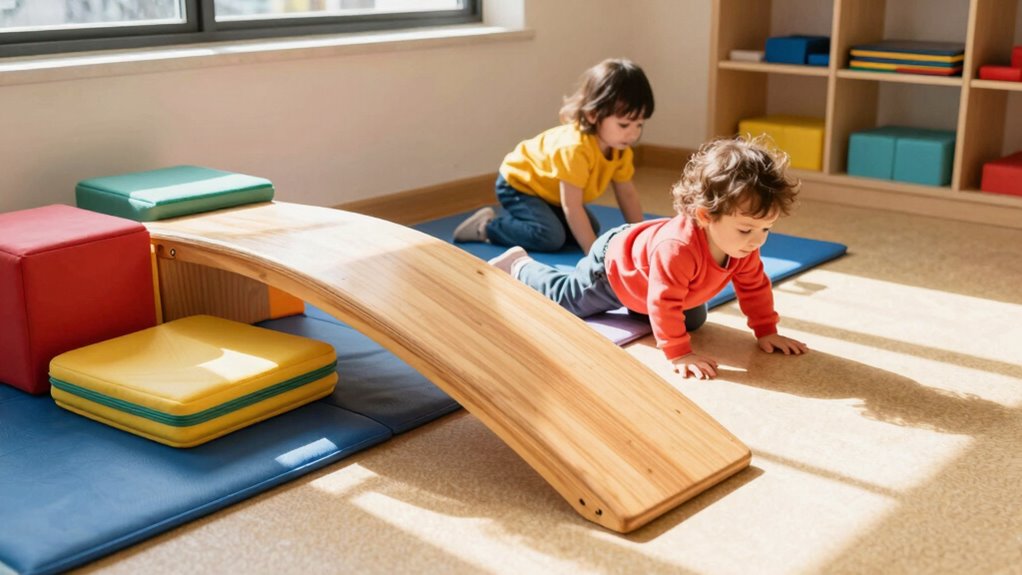
Introducing ramps into preschool spaces offers a simple yet powerful way to explore basic scientific concepts like gravity, motion, and stability. When children roll balls or push toy cars down ramps, they engage in hands-on physics experiments that reveal how objects move and respond to different angles. These activities help kids understand the relationship between height and speed, illustrating how gravity pulls objects downward. As they experiment with various ramp inclines, they quickly see that steeper slopes cause faster movement, making abstract ideas like acceleration more tangible. This approach fosters curiosity and encourages kids to observe, predict, and test their ideas about motion in a playful environment. Additionally, understanding basic physics principles helps children develop a foundational knowledge that supports future scientific learning.
Incorporating ramps also presents engineering challenges that stimulate critical thinking and problem-solving skills. For example, children might try to design a ramp that makes a toy car travel further or faster, requiring them to think about factors like surface friction, length, and angle. They learn to troubleshoot when their initial designs don’t work as planned, developing resilience and adaptability. These engineering challenges promote a mindset of experimentation, as children test their hypotheses and refine their structures based on real-world outcomes. Through trial and error, they grasp that engineering involves iterative processes—building, testing, adjusting—that are fundamental to scientific inquiry. Recognizing engineering processes in their activities helps children see how science and engineering are interconnected, fostering a comprehensive understanding of both fields.
Using ramps in preschool spaces makes complex ideas accessible and engaging. You might set up different types of ramps—straight, curved, or with obstacles—and see how children interact with each variation. They’ll explore concepts like stability, balance, and the importance of smooth surfaces, which are key in engineering design. These activities naturally integrate physics experiments with engineering challenges, providing a holistic learning experience. Children see firsthand how science and engineering are interconnected, fostering a deeper understanding of both fields. Furthermore, incorporating hands-on experiments encourages active learning and helps solidify abstract concepts through tangible experiences.
Moreover, ramps encourage collaborative learning. Kids often work together to build or modify ramps, sharing ideas and strategies. This social aspect enhances communication skills and teaches the value of teamwork in solving problems. As they observe each other’s experiments and share discoveries, they develop a sense of scientific inquiry that extends beyond the classroom. Incorporating ramps into preschool spaces not only introduces foundational science concepts but also ignites a lifelong interest in how things work. You’re creating a dynamic environment where curiosity drives exploration, and every experiment or engineering challenge becomes an opportunity for growth and discovery.
Products Worth Considering

LEGO Icons Tranquil Garden Building Set – Japanese Zen Garden DIY Kit for Adults, 10315

LEGO Boost Creative Toolbox 17101 Robot Building and Coding Kit, 847 Pieces

Graco SlimFit 3-in-1 Convertible Car Seat, Jarret
As an affiliate, we earn on qualifying purchases.
Frequently Asked Questions
How Do Ramps Support Inclusive Play for Children With Disabilities?
Ramps support inclusive play for children with disabilities by acting as adaptive equipment that guarantees easy access to play areas. They allow children with mobility challenges to participate alongside their peers, fostering social integration. By incorporating ramps, you create an environment where every child feels welcome and capable, encouraging shared activities and friendships. This promotes a sense of belonging and helps build confidence through inclusive, accessible play experiences.
What Materials Are Safest for Constructing Preschool Ramps?
You should choose materials that meet safety standards and are durable for constructing preschool ramps. Opt for slip-resistant surfaces like textured rubber or non-slip coatings to prevent accidents. Use sturdy, weather-resistant materials such as treated wood, metal, or high-quality plastics that can withstand daily wear and tear. Ensuring the materials are safe, durable, and compliant with safety standards helps create a secure environment where children can explore and learn confidently.
How Can Ramps Be Integrated Into Daily Preschool Routines?
You can integrate ramps into daily preschool routines by making playground accessibility and classroom mobility seamless. Encourage children to use ramps during free play, shifts, and structured activities like obstacle courses. Incorporate them into storytime or group exercises to promote independence and physical development. By consistently using ramps, you help children develop confidence, support inclusive play, and guarantee everyone can comfortably access all areas of your preschool space.
Are There Age-Specific Ramp Design Considerations?
Yes, there are age-specific ramp design considerations. You should focus on safety, ensuring gentle slopes and sturdy handrails suitable for preschoolers’ size and strength. Incorporate appealing design aesthetics to make ramps inviting and engaging. Keep cost considerations in mind by using durable, easy-to-maintain materials that fit your budget. Tailoring ramp features to preschoolers’ developmental stages promotes independence while ensuring safety and accessibility in your space.
What Maintenance Is Required for Preschool Ramps?
Think of preschool ramps as the backbone of safe play—requiring regular attention to stay strong. You should conduct safety inspections routinely to catch any issues early. Keep an eye on material durability, checking for cracks, rust, or wear that could jeopardize safety. Clean the ramps often to prevent buildup of dirt or debris, and promptly repair any damages. Proper maintenance guarantees these ramps remain safe, sturdy, and inviting for little explorers.
Conclusion
By incorporating ramps into preschool spaces, you make science both accessible and fun for young learners. These simple structures spark curiosity, encourage exploration, and help children understand concepts like gravity and motion. Imagine watching their faces light up as they discover how ramps work—doesn’t that make learning exciting? When you bring hands-on science into their environment, you’re not just teaching; you’re inspiring a lifelong love of discovery.