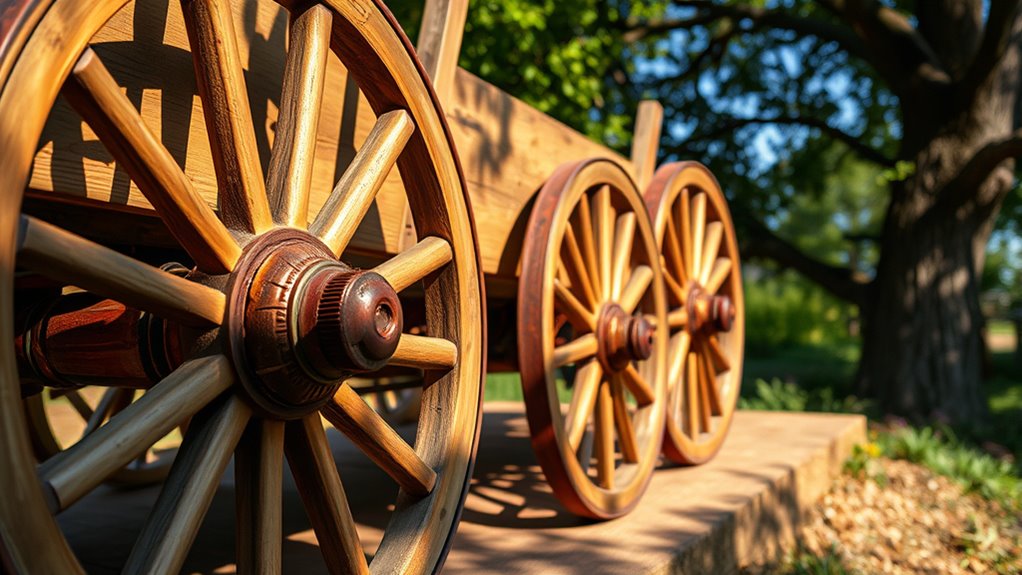

Simple machines on wheels, like wheels and axles, help you move objects smoothly and easily. Wheels spin and reduce friction, making transportation simpler, while axles connect wheels to devices like bikes and carts, multiplying effort. Inclined planes, like ramps, make lifting heavy loads easier by spreading work over a longer distance. Combining these tools shows how clever design saves effort and improves daily tasks—continue exploring to discover more about their amazing functions.
Key Takeaways
- Wheels and axles work together to enable smooth movement and reduce effort in transportation devices.
- Axles connect wheels to objects, allowing them to rotate and transfer force efficiently.
- Inclined planes, like ramps, decrease the force needed to lift or move heavy loads on wheels.
- Combining wheels, axles, and inclines makes tasks like pushing carts and loading easier and more effective.
- These simple machines are widely used in everyday objects such as bicycles, cars, and luggage to improve mobility.

Have you ever wondered how some tasks become easier with just a little push or pull? It’s often thanks to simple machines, like wheels, axles, and inclined planes, that make work feel less like a burden. These tools might seem straightforward, but they pack a lot of power in helping us move heavy loads or change the direction of force. When you think about a wheelbarrow, for example, it’s not just a container for carrying things—it’s a combination of wheels and an axle that drastically reduces the effort needed to transport heavy loads. By rolling instead of dragging, you save energy and avoid strain. That’s the magic of these simple machines working together.
Simple machines like wheels and axles make heavy work easier and more efficient.
Wheels and axles are among the most common and effective simple machines on wheels. The wheel allows you to roll objects smoothly across surfaces, reducing friction and making movement easier. The axle, which runs through the center of the wheel, connects the wheel to the object it’s attached to and helps transfer force. When you turn the wheel, you’re applying force to the axle, which then turns the wheel. This setup multiplies your effort, so you don’t have to push or pull as hard. Think about a bicycle: pedaling turns the wheel through the axle, propelling you forward with less effort than dragging the bike along. You can see how this combination is essential in many devices, from cars to skateboards, making transportation more efficient.
Inclined planes, like ramps, are another key simple machine that works on the principle of reducing the force needed to lift or move objects. Instead of lifting straight up, which takes a lot of effort, you can slide an object up an incline, spreading the work over a longer distance. When you use a ramp to load furniture into a truck, you’re leveraging the incline to decrease the force required. It might take more effort overall to push the object up the ramp, but because the force is applied over a longer path, it feels easier. This principle is why ramps are so useful in construction, loading, and even everyday activities like stepping onto a curb. You’re actually using the power of simple machines to make challenging tasks manageable.
Together, wheels, axles, and inclined planes demonstrate how simple machines aren’t just basic tools—they’re fundamental in making work easier for everyone. By understanding how they work and how they’re combined, you can appreciate the clever ways humans have found to reduce effort and improve efficiency. Whether pushing a cart, rolling a suitcase, or climbing a ramp, you’re benefiting from the simple yet powerful principles behind these machines. They remind you that even the simplest tools can have a big impact on everyday life.
bicycle wheel and axle parts
As an affiliate, we earn on qualifying purchases.
As an affiliate, we earn on qualifying purchases.
Frequently Asked Questions
How Do Axles Reduce Friction?
Axles reduce friction by allowing wheels to spin smoothly around a fixed point. When you turn a wheel, the axle acts as a pivot, minimizing contact between moving parts and the surface. This design decreases resistance, making it easier for you to move objects or vehicles. By reducing friction, axles help you save effort and improve efficiency when rolling or transporting loads.
What Materials Are Best for Wheels?
You should choose lightweight, durable materials like aluminum or plastic for wheels, as they reduce overall weight and improve efficiency. Rubber tires offer good traction and shock absorption, making them ideal for many applications. For heavy-duty use, consider steel or composite materials, which provide strength and longevity. Avoid fragile materials like glass or thin plastics, since they can break easily and increase maintenance issues.
How Do Inclines Affect Load Effort?
Inclines increase your effort exponentially, making lifting loads seem more laborious. When you face an incline, you’re fighting gravity’s grip, requiring additional strength to push or pull. The steeper the slope, the more effort you need to exert. You’ll notice this as you navigate inclines with loads, feeling the added strain. To ease this, you can use wheels, ramps, or leverage to lessen the load and lessen your exertion.
Can These Simple Machines Be Combined?
Yes, you can combine simple machines like wheels, axles, and inclines to make tasks easier. For example, attaching wheels to a ramp reduces effort when moving heavy objects up an incline. Using levers and pulleys together can also decrease the force needed. Combining these machines creates more efficient tools, saving you energy and effort in lifting, moving, or lifting loads. It’s a smart way to work smarter, not harder.
What Are Modern Applications of These Machines?
You use modern applications of these machines every day, like in cars, bicycles, and escalators. They help you move heavy loads more easily, improve transportation efficiency, and make daily tasks smoother. Engineers also design wheel and axle systems for manufacturing machines and robotics. By understanding these simple machines, you can appreciate how they optimize movement and force, making your life simpler and more efficient.
loading ramp for trucks
As an affiliate, we earn on qualifying purchases.
As an affiliate, we earn on qualifying purchases.
Conclusion
So, next time you roll your eyes at a wheel or scoff at an incline, remember—they’re just tiny helpers making your life easier. Without these simple machines, you’d be stuck lifting, pushing, or dragging everything yourself. But hey, who needs efficiency when you can struggle the old-fashioned way? So go ahead, ignore those wheels—just don’t complain when your effort feels like pushing a boulder uphill. Sometimes, simplicity really is the secret to not exhausting yourself.
shopping cart wheels and axles
As an affiliate, we earn on qualifying purchases.
As an affiliate, we earn on qualifying purchases.
wheelbarrow with wheels and axles
As an affiliate, we earn on qualifying purchases.
As an affiliate, we earn on qualifying purchases.