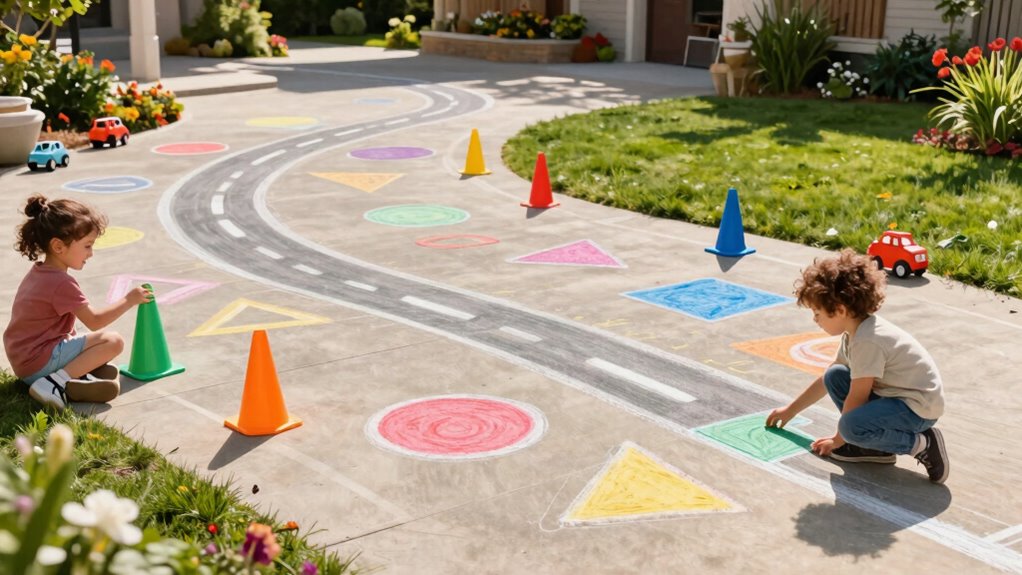
Creating shape roads outdoors is a fun and simple activity that boosts your preschooler’s motor skills, creativity, and spatial awareness. Use bright colors and easy-to-recognize shapes like circles, squares, and triangles to design winding paths, straight roads, or roundabouts. These features encourage exploration, problem-solving, and active play while teaching important concepts about direction and space. Keep exploring for more ideas on how shape roads can make outdoor play engaging and educational.

Turn the school run and nap time into listening time
- Thousands of audiobooks, podcasts and originals
- Listen on your phone, tablet or Echo — also offline
- Cancel anytime
Key Takeaways
- Use colorful, simple shapes like circles, squares, and winding paths to create engaging outdoor road activities for preschoolers.
- Incorporate real-world elements such as crosswalks, stop signs, and traffic lights to teach safety and spatial awareness.
- Design themed roads with interactive features like roundabouts and parking bays to boost creativity and exploration.
- Involve children in planning and building the roads to foster ownership, teamwork, and understanding of shapes and directions.
- Use outdoor roads to promote active play, motor skills, environmental awareness, and cognitive development through hands-on activities.
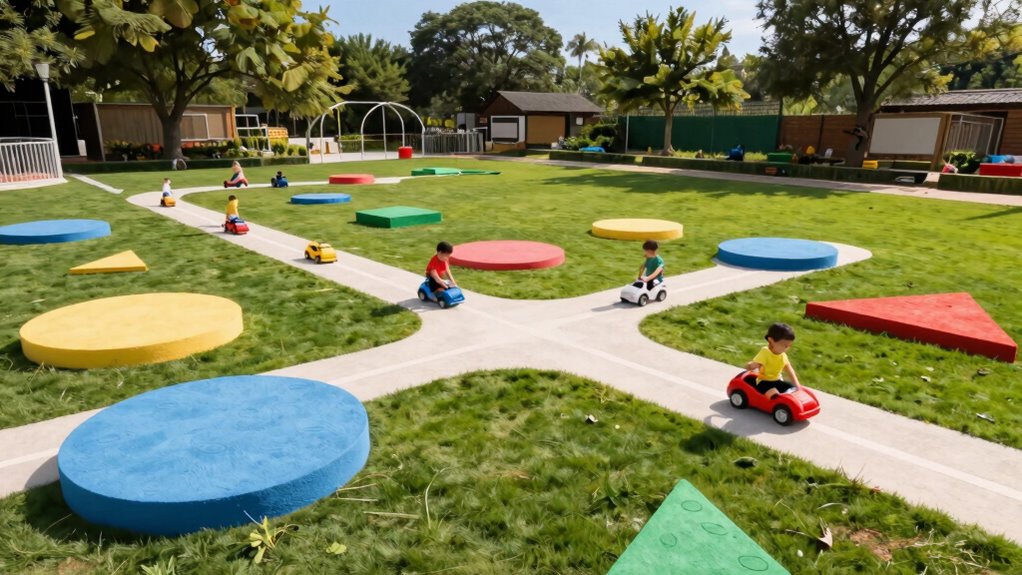
Creating outdoor roads that are both functional and visually appealing requires thoughtful design and careful planning. When you design roads for preschoolers, safety is your top priority. You want to guarantee that traffic safety is maintained so that children can learn and play without risk. Using bright colors, clear markings, and simple shapes can help young kids recognize different parts of the road easily. For example, drawing stop signs, crosswalks, and traffic lights with bold lines makes the environment engaging and educational. These small details not only keep children safe but also introduce them to basic traffic rules early on. When you make the roads attractive and easy to understand, children are more likely to stay within designated areas, reducing the risk of accidents.
Beyond safety, shaping outdoor roads offers numerous outdoor play benefits that support a child’s physical and cognitive development. When you create winding paths, straight roads, or circular tracks, you’re inviting children to explore movement and coordination. They can practice walking, running, or riding bikes, which enhances their motor skills. Incorporating different shapes and patterns into the roads encourages creativity and spatial awareness. Kids love the opportunity to imagine driving cars or navigating a miniature city, which helps develop their problem-solving skills and social interactions. Playing on these roads also promotes outdoor activity, which is essential for their overall health, offering fresh air and exercise that indoor play can’t replicate. Additionally, designing these roads with environmental awareness in mind can introduce children to concepts of sustainability and caring for nature from an early age. Incorporating educational elements like signs and symbols can further enhance their learning experience. Incorporating sustainable design practices into your outdoor setup can also teach children about environmental responsibility from an early age.
Designing these outdoor roads with appeal in mind keeps children engaged for longer periods. Bright colors, interesting shapes, and thematic elements like pretend traffic signals or parking lots make the activity more immersive. You can even add features like small intersections, roundabouts, or parking bays to simulate real-world scenarios, making the activity both fun and educational. As children follow the roads, they learn about spatial relationships and develop their understanding of directions and distances. This type of active play supports their cognitive growth while giving them a chance to stretch their legs and burn off energy. Incorporating educational concepts such as biodiversity into outdoor activities can also foster an early appreciation for the environment and sustainable living. Plus, when you involve them in planning or creating the roads, it boosts their sense of ownership and encourages cooperative play.
As an affiliate, we earn on qualifying purchases.
Frequently Asked Questions
What Age Group Is Best Suited for This Activity?
This activity is best suited for preschoolers aged 3 to 5 years. You’ll notice it helps develop shape recognition as children identify different road shapes. Plus, it boosts their motor skills through outdoor movement and active play. You can easily adapt the activity to suit different developmental levels, making it perfect for young children to learn shapes while improving coordination and motor control in a fun, engaging way.
How Can I Adapt the Activity for Limited Outdoor Space?
You can adapt this activity for limited outdoor space by creating indoor alternatives using a compact design. Use painter’s tape on your floors or carpets to make roads and intersections, allowing your preschooler to play safely inside. You might also use small toys or cardboard cutouts to simulate vehicles. This way, your child can enjoy the same creative, engaging experience without needing large outdoor areas.
Are There Safety Precautions to Consider During This Activity?
Yes, you should supervise children closely during this activity to guarantee safety. Keep hazard awareness in mind by inspecting the area for sharp objects, uneven surfaces, or obstacles that could cause falls. Use supervision tips like maintaining visual contact and setting clear boundaries. Also, remind kids to be careful with chalk or other materials, and encourage them to stay within designated play zones to prevent accidents.
What Materials Are Needed to Set up Shape Roads?
To set up shape roads, you’ll need simple materials like chalk, painter’s tape, or rope to outline the shapes. Did you know that outdoor play boosts preschoolers’ motor skills by over 30%? Using these materials helps teach traffic safety while making playtime fun. You can create various shapes on sidewalks or lawns, encouraging kids to navigate and learn road rules in a safe, outdoor environment.
How Can I Incorporate Learning About Shapes Into This Activity?
You can incorporate learning about shapes into this activity by encouraging kids to identify and name different shapes as they build their roads. Challenge them to create specific shapes like circles, squares, or triangles, which promotes shape recognition. As they trace and maneuver, they also enhance their motor skills. Make it fun by asking questions like, “Can you make a big triangle or a tiny circle?” to boost their understanding and engagement.
Conclusion
Creating shape roads outdoors is a fun way to boost early learning and motor skills. Kids love turning driveways into winding circles or straight lines, making education playful. Did you know that hands-on activities like this can improve spatial awareness by up to 30%? So next time you’re outside, grab some chalk and let your child’s imagination drive the way. It’s simple, engaging, and proven to support their developmental growth!
Halloween Picks
halloween
As an affiliate, we earn on qualifying purchases.