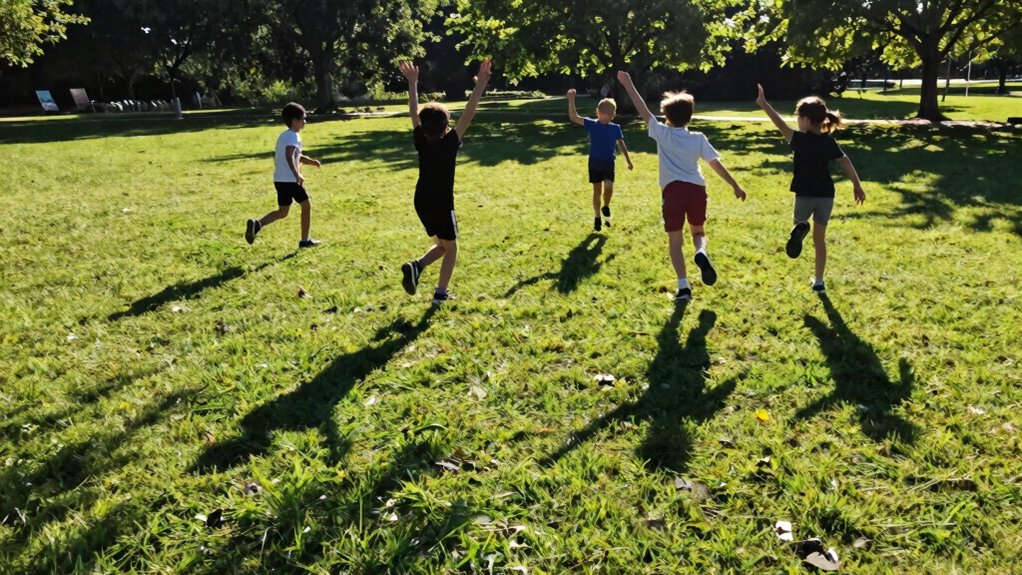

During outdoor play, you can easily incorporate shadow tracking to teach kids about the sun’s movement. Have children observe how shadows change in length at different times of day, using simple tools like tape or pacing to measure. Ask questions to spark curiosity, such as why shadows are longer in the morning and evening. These activities make abstract concepts tangible and fun. Keep exploring to discover more ways to turn outdoor play into an engaging science lesson.

Turn the school run and nap time into listening time
- Thousands of audiobooks, podcasts and originals
- Listen on your phone, tablet or Echo — also offline
- Cancel anytime
Key Takeaways
- Incorporate shadow observation into outdoor play to make learning about the sun’s movement engaging and interactive.
- Use simple tools like measuring tapes or pacing to record shadow lengths at different times.
- Ask children why shadows change to promote curiosity and understanding of Earth’s rotation and solar position.
- Track shadow length throughout the day to visually demonstrate the sun’s changing position in the sky.
- Connect shadow patterns to scientific concepts like time of day, Earth’s rotation, and celestial movement.
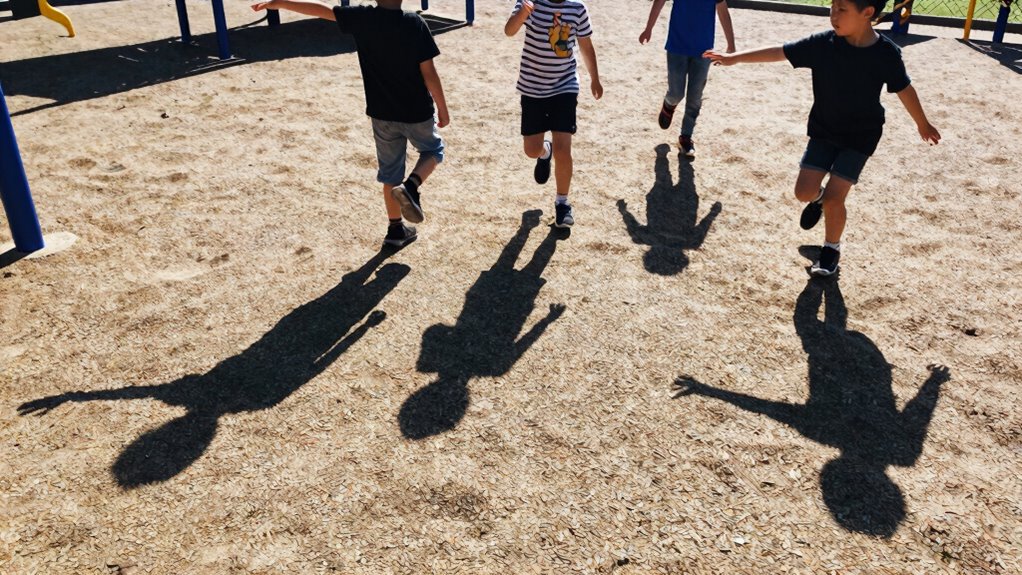
When children play outdoors, their shadows provide a fascinating opportunity for learning and exploration. As they run, jump, and explore, their shadows shift and change, offering a natural way to observe the relationship between the sun and the environment. One of the most interesting aspects to notice is shadow length, which varies depending on the sun’s position in the sky. When the sun is high overhead, shadows become short and compact. As the sun moves lower in the sky, especially during early morning or late afternoon, shadows stretch out longer across the ground. This simple observation can spark curiosity and serve as an introduction to basic science concepts.
Children’s shadows change with the sun’s position, offering a fun way to explore basic science concepts outdoors.
You can encourage kids to pay attention to how their shadows change throughout the day. When they see their shadow elongate, you can ask, “Why do you think your shadow is longer now?” This prompts them to think about the sun’s position—when the sun is lower, shadows grow longer, and when it’s higher, shadows shrink. This natural, hands-on experience makes the concept accessible and engaging without the need for complex explanations. You might even suggest they track their shadow length at different times, creating a mini science project right during playtime.
Using a simple measuring tape or even just pacing, children can record their shadow lengths at various points in the day. As they do this, they’ll notice a pattern: shadows are longer in the morning and late afternoon and shorter around midday. This activity helps them understand the sun’s movement across the sky and how it influences shadows. It’s an easy addition to outdoor play that turns a fun game into a learning opportunity. Recognizing how the Earth’s rotation causes the sun to move across the sky can help children connect these shadow changes to broader scientific principles. Additionally, understanding the sun’s movement can deepen their appreciation of the natural world and how it affects everyday life. It also introduces them to the concept of celestial movement, which is fundamental to understanding how the universe works. Furthermore, observing the changes in shadows over time can help children grasp the concept of time of day and its relation to the Earth’s rotation.
You can also introduce the idea that the sun’s position isn’t fixed; it moves steadily across the sky, causing these changes in shadow length. Explaining that the sun appears higher in the sky at noon and lower in the morning and evening helps children grasp a basic understanding of the Earth’s rotation. As they observe and record shadow changes, they’re actively engaging with these fundamental concepts, making abstract ideas more tangible. Plus, they get to practice measuring, recording data, and observing patterns—all valuable scientific skills. Incorporating shadow tracking into outdoor play transforms a simple activity into an interactive science lesson. It encourages observation, measurement, and curiosity—all while kids are just having fun. By paying attention to how their shadows grow and shrink, children learn about the sun’s position and how it influences the world around them, turning everyday play into a meaningful, educational experience.
As an affiliate, we earn on qualifying purchases.
Frequently Asked Questions
How Can Shadow Tracking Enhance Children’s Understanding of the Sun’s Movement?
Shadow tracking helps you see how the sun’s movement affects shadows, making shadow theory tangible for children. By observing how shadows change in length and direction throughout the day, kids grasp solar angles and understand the sun’s path across the sky. This hands-on activity deepens their comprehension of the sun’s movement, encouraging curiosity and providing a practical way to explore basic concepts in astronomy and physics.
What Materials Are Best for Creating Simple Shadow Tracking Tools?
Think of shadow puppets as your tools for a solar angle adventure. Use simple materials like craft sticks, paper, or cardboard to create shapes that cast distinct shadows. You can also use a ruler or protractor to measure the length of shadows, helping kids understand how the solar angle changes throughout the day. These materials are affordable, easy to handle, and perfect for hands-on outdoor exploration.
How Does Weather Affect the Accuracy of Shadow Tracking Activities?
Weather patterns considerably impact the accuracy of shadow tracking activities. Bright, sunny days provide sharp, well-defined shadows, making tracking easier. Overcast skies cause shadow distortion, reducing clarity and precision. Wind or humidity can also alter the positioning and length of shadows, leading to inaccuracies. To get the most precise results, plan activities during clear, stable weather conditions and be aware of how changing weather patterns might influence shadow behavior.
Can Shadow Tracking Be Adapted for Indoor Science Lessons?
Yes, you can adapt shadow tracking for indoor science lessons by doing indoor light experiments and creating shadow puppets. Use a flashlight or lamp as your light source, and have students observe how shadows change with different objects or angles. You can also encourage them to make shadow puppets, exploring how size and shape affect shadows. This hands-on approach makes shadow tracking engaging and educational, even indoors.
What Safety Precautions Should Be Taken During Outdoor Shadow Experiments?
You should prioritize shadow safety by ensuring constant outdoor supervision, especially when children are near busy areas or uneven terrain. Keep an eye on sun exposure, encouraging breaks to avoid sunburns and dehydration. Use sunscreen, hats, and sunglasses. Remain vigilant about weather changes, and establish clear boundaries to prevent wandering. By maintaining active supervision and safety measures, you keep the experiment fun and secure, turning curiosity into a safe outdoor adventure.
Conclusion
As you explore shadow tracking during outdoor play, you’ll find it’s like uncovering a hidden world right beneath your feet. This simple science activity sparks curiosity and boosts observational skills, making learning fun and effortless. Just like shadows shift with the sun, your understanding of light and movement will grow with each new discovery. So, grab your kids and start tracking—they’ll love the adventure, and you’ll enjoy watching their curiosity shine brighter than ever.
Evergreen bestsellers Picks
bestsellers
As an affiliate, we earn on qualifying purchases.