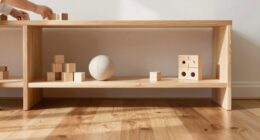
As a parent, your role in child-led play is to support and encourage your child’s autonomy by modeling enthusiasm, curiosity, and respectful engagement. You should set clear boundaries to create a safe space, while remaining actively present to observe and gently guide when needed. Asking open-ended questions and joining in play fosters confidence and creativity. If you’re curious about how to balance involvement with independence, keep exploring these strategies.
Key Takeaways
- Support child autonomy by following their lead and encouraging exploration during play.
- Model curiosity, problem-solving, and enthusiasm to inspire similar behaviors in children.
- Practice active listening to understand child’s ideas and provide responsive guidance.
- Establish clear boundaries to ensure safe, structured play that fosters self-regulation.
- Balance involvement by observing, asking open-ended questions, and offering gentle suggestions.

Have you ever wondered how your involvement influences your child’s play? When your child engages in child-led play, your role isn’t about directing or controlling the activity but about supporting their independence and creativity. One of the most effective ways you can do this is through modeling strategies. Children often learn by observing, so your actions, words, and attitudes serve as powerful examples. Show enthusiasm for their ideas, ask open-ended questions, and demonstrate curiosity. For instance, if they’re building with blocks, join in by showing how to stack or create something new, all while letting them lead the process. This kind of positive modeling encourages your child to explore and problem-solve on their own, building confidence in their abilities. Additionally, understanding the importance of active listening can greatly enhance your support, as it helps you better interpret your child’s needs and ideas.
At the same time, setting boundaries is vital, even during child-led play. Boundaries provide a safe framework within which your child can experiment and learn. You might establish rules about sharing toys, respecting each other’s space, or keeping play areas safe. These boundaries aren’t about restricting creativity; instead, they help your child understand limits and develop self-regulation. When boundaries are clear and consistent, children feel secure and are more willing to explore freely within those guidelines. For example, you might say, “We can play with these toys, but we need to be gentle and share with others,” which sets a fair boundary without stifling their autonomy.
Your involvement should be balanced—being present enough to guide without taking over. You can observe their play, offer gentle suggestions, or ask questions that prompt deeper thinking, like “What do you think happens next?” or “How did you decide to do that?” This approach encourages your child’s decision-making and problem-solving skills, reinforcing their sense of agency. Remember, your role is to support their exploration, not to direct it. By modeling positive strategies and setting appropriate boundaries, you create a secure environment where your child feels confident to lead their play. This promotes emotional resilience, social skills, and creativity—all essential for their development.
In essence, your involvement during child-led play shapes how your child perceives risks, boundaries, and their own abilities. When you model strategies that showcase curiosity and respect boundaries that foster safety, you’re nurturing a confident, independent, and emotionally healthy child. Your presence becomes a steadying force that encourages exploration and learning, helping your child grow into a self-assured individual capable of *finding their way* in the world with curiosity and resilience.

ArtCreativity Light Up Transparent Sensory Car Toy for Kids, 1PC, Bump and Go Toy Car with Colorful Moving Gears, Music, and LED Effects, Easter Toys for Toddlers, Great Birthday Gift Idea
FUEL THE EXCITEMENT: A car toy that takes fun to fast and furious extremes! This transparent toy car…
As an affiliate, we earn on qualifying purchases.
As an affiliate, we earn on qualifying purchases.
Frequently Asked Questions
How Can Parents Encourage Creativity During Child-Led Play?
Encouraging creativity during child-led play involves giving your child space for imaginative exploration and creative expression. You can do this by providing open-ended materials like art supplies, dress-up clothes, or building blocks, and then stepping back to let their ideas flourish. Ask open-ended questions to inspire new ideas, and avoid directing their play, so they feel free to explore their imagination fully. Your support nurtures their creative confidence.
What Are Common Challenges Parents Face With Child-Led Play?
You might find it challenging to allow child-led play without parental interference or setting unrealistic expectations. It’s natural to want to guide your child, but stepping back helps foster independence and creativity. Sometimes, you may worry they’re not learning enough or not playing “correctly.” Remember, patience is key. Trust their instincts, resist the urge to control, and embrace the messiness—child-led play is about exploration, not perfection.
How Does Child-Led Play Impact Emotional Development?
Think of child-led play as a garden where your child’s emotional resilience and self-awareness bloom. It helps them navigate feelings, build confidence, and handle setbacks like sturdy trees. You’re nurturing their emotional development, enabling them to understand themselves better and grow stronger emotionally. Through open-ended exploration, they learn to manage emotions, fostering independence and resilience, which are crucial for facing life’s challenges with a steady heart and mind.
What Safety Tips Should Parents Consider During Child-Led Activities?
When considering safety tips during child-led activities, prioritize playground safety by inspecting equipment regularly and choosing age-appropriate areas. Use supervision strategies like staying close and observing without interrupting, so kids can explore freely while staying safe. Always set clear boundaries and teach children about safe play. This way, you encourage independence while ensuring they’re protected from potential hazards, making play both fun and secure.
How Can Parents Balance Guidance and Independence in Play?
Imagine a playtime where you’re both guiding and stepping back—how do you strike that perfect balance? You set boundaries to guarantee safety and structure, yet foster autonomy by allowing your child to explore freely. Keep observing, offering gentle prompts, and knowing when to step in or step back. This dance of guidance and independence creates a space where your child learns confidently, feeling supported yet free to lead their own play.

OESSUF Extra-Large Stacking Rocks for Toddlers 1-3, 16 PCS Wooden Montessori Toys, Safe Smooth Jumbo Balancing Stones for Open-Ended Sensory Play, STEM Building Blocks for Boys & Girls
Extra-Large & Safe for Toddlers 1-3: 16 PCS jumbo wooden stacking rocks designed for small hands. Smooth, BPA-free…
As an affiliate, we earn on qualifying purchases.
As an affiliate, we earn on qualifying purchases.
Conclusion
In child-led play, your role is to be a supportive guide rather than a director. By stepping back and letting your child lead, you help foster independence, creativity, and confidence. Remember, sometimes you have to let the children take the wheel to truly see what they’re capable of. When you strike the right balance, you’ll find that their growth blossoms naturally, proving that a little space goes a long way in nurturing a child’s potential.

My Body, My Rules : Understanding Our Bodies: A Guide for Kids on Body Safety, Personal Boundaries, and Healthy Development
As an affiliate, we earn on qualifying purchases.
As an affiliate, we earn on qualifying purchases.

Doctor Kit for Toddlers 3-5 Kids Doctors Play Set with Interactive Learning Tablet Toys for 3 Year Old Boy Girl Pretend Play Toys with Sound & Music Stethoscope Birthday Gift Baby Toddler Toys 2-3 2-4
【Doctor Kit for Toddlers 3-5】Our kids doctors play set includes a musical toddler tablet, stethoscope, thermometer, syringe, tweezers,…
As an affiliate, we earn on qualifying purchases.
As an affiliate, we earn on qualifying purchases.