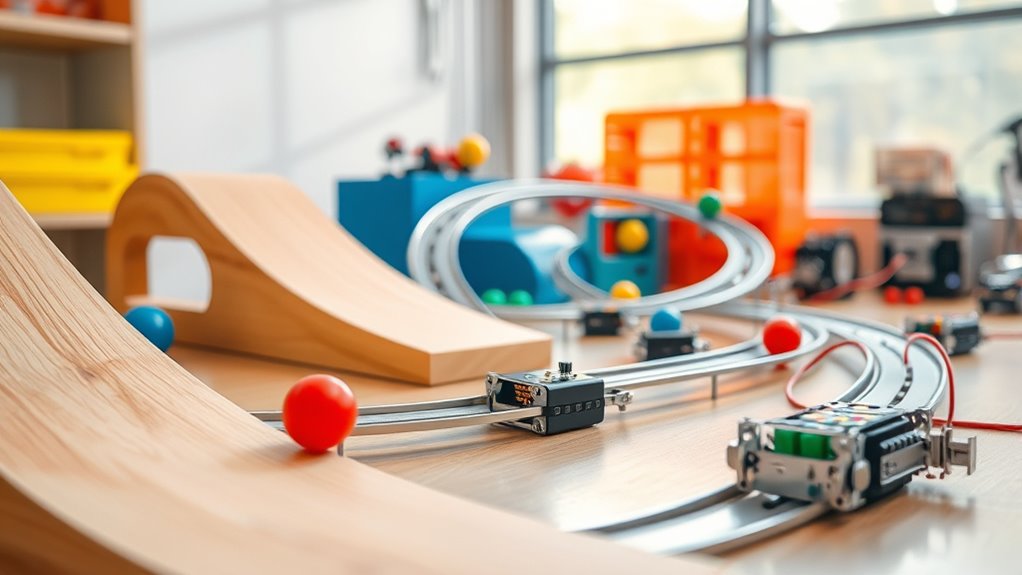

Science corners with ramps and tracks let you explore physics in a fun, hands-on way. You can build different tracks to see how gravity, friction, and energy affect moving objects. Experiment with slopes, surfaces, and shapes to understand motion and energy transfer better. These activities make complex science concepts easy to grasp and engaging. Keep exploring, and you’ll discover how these simple tools reveal the fascinating principles that govern our physical world.

Turn the school run and nap time into listening time
- Thousands of audiobooks, podcasts and originals
- Listen on your phone, tablet or Echo — also offline
- Cancel anytime
Key Takeaways
- Science corners with ramps and tracks provide hands-on opportunities to explore motion, gravity, and energy transfer.
- They allow experimentation with different slopes, surfaces, and shapes to observe effects on speed and friction.
- Constructing and adjusting ramps helps visualize principles like acceleration, momentum, and energy conservation.
- These setups foster critical thinking through predicting, testing, and recording observations of physical behaviors.
- Using ramps and tracks makes learning physics engaging, promotes problem-solving skills, and enhances curiosity about science concepts.

Have you ever wondered where science comes alive in your everyday environment? It’s often right in front of you, hidden in simple things like ramps and tracks. These objects aren’t just for play—they’re powerful tools that demonstrate fundamental scientific principles. When you set up a science corner with ramps and tracks, you create a mini laboratory where you can explore motion, gravity, friction, and energy transfer firsthand. Whether you’re a curious kid or an adult looking to understand how the world works, these tools make learning both accessible and engaging.
Imagine constructing a ramp out of wood, plastic, or even cardboard. As you place a small ball or toy car at the top, you begin to see physics in action. Gravity pulls the object downward, accelerating it as it moves. You can observe how the steepness of the ramp affects the speed—making the incline steeper results in a faster descent. This simple setup helps you grasp the concept of acceleration and how gravity influences objects in motion. You might even experiment with different materials for the ramp surface to see how friction slows the object down. A slick, smooth surface reduces resistance, letting the object glide farther, while a rough surface increases friction, slowing it down. These tiny experiments reveal how friction is a force that opposes motion, a key idea in physics.
Construct a ramp and observe how slope and surface materials affect the speed and friction of rolling objects.
Tracks extend this exploration further. They allow you to study how different shapes and angles influence movement. You can set up a track with curves, loops, and inclines to observe how momentum carries an object through a series of challenges. For example, rolling a marble through a track with a loop demonstrates how energy is conserved—potential energy at the top transforms into kinetic energy as it speeds through the loop. If you add obstacles or change the track’s surface, you see how energy transfer and friction affect the marble’s journey, giving you a tangible sense of energy conservation and loss.
Creating a science corner with ramps and tracks encourages experimentation and critical thinking. You can record your observations, make predictions, and test different setups to see what works best. This hands-on approach makes abstract scientific ideas concrete, helping you understand the laws that govern motion and energy. Plus, it’s a fun way to develop problem-solving skills and curiosity about the physical world. Every time you build a new track or ramp, you’re not just playing—you’re engaging with fundamental principles that shape everything around you. It’s science made simple, accessible, and exciting, right in your own space.
As an affiliate, we earn on qualifying purchases.
Frequently Asked Questions
How Do Ramps Affect the Speed of Objects on Tracks?
Ramps increase the speed of objects on tracks by providing a slope that converts potential energy into kinetic energy. When you release an object from a higher point, gravity pulls it downward, accelerating it as it moves along the ramp. The steeper the ramp, the faster the object will go because more force is exerted on it, helping it pick up speed quicker as it travels along the track.
What Materials Are Best for Building Durable Science Corners?
You should choose durable materials like hardwood, plastic, or metal for building science corners. Hardwood is strong and long-lasting, while plastic offers lightweight flexibility and resistance to moisture. Metal, such as aluminum or steel, provides exceptional durability and strength. Avoid soft or easily breakable materials like foam or thin plastic, as they won’t withstand frequent use. Selecting these sturdy options guarantees your science corners stay intact and functional over time.
Can Ramps Be Customized for Different Experiments?
Absolutely, ramps can be customized for different experiments, and it’s surprisingly simple. You might think they’re just static, but you can change angles, lengths, and surfaces to suit your needs. Want to test different materials or modify the incline? No problem. Just adjust the design, and your ramp becomes a versatile tool for hands-on learning. It’s like giving your experiments a personalized playground—so much more engaging and flexible!
How Do Gravity and Friction Influence Track Experiments?
Gravity pulls objects downward, affecting how fast or slow they travel on the track, while friction slows them down by resisting motion. When you change the angle of the ramp, gravity‘s influence increases, making objects accelerate faster. Friction depends on the surface, so smoother tracks reduce resistance, allowing objects to move more freely. Understanding these forces helps you predict and control the outcomes of your track experiments effectively.
Are There Safety Guidelines for Constructing Science Corners?
Yes, there are safety guidelines you should follow when constructing science corners. Always supervise children during setup and experiments, guarantee the area is clear of hazards, and use sturdy, non-slip surfaces. Wear protective gear like goggles and gloves when necessary, and keep sharp tools out of reach. Make sure all equipment is secure to prevent tipping or falling, and encourage safe handling of materials to prevent accidents.
Conclusion
As you explore science corners with ramps and tracks, remember how a simple marble can turn a plain surface into a thrilling experiment. Just like that marble, your curiosity rolls forward, discovering how gravity and motion work together. Think of each experiment as a small adventure—each turn and slide revealing a new secret of the universe. Keep exploring, because every little discovery builds your understanding, turning your curiosity into a lifelong passion for science.
Cold & flu season Picks
humidifiers
As an affiliate, we earn on qualifying purchases.