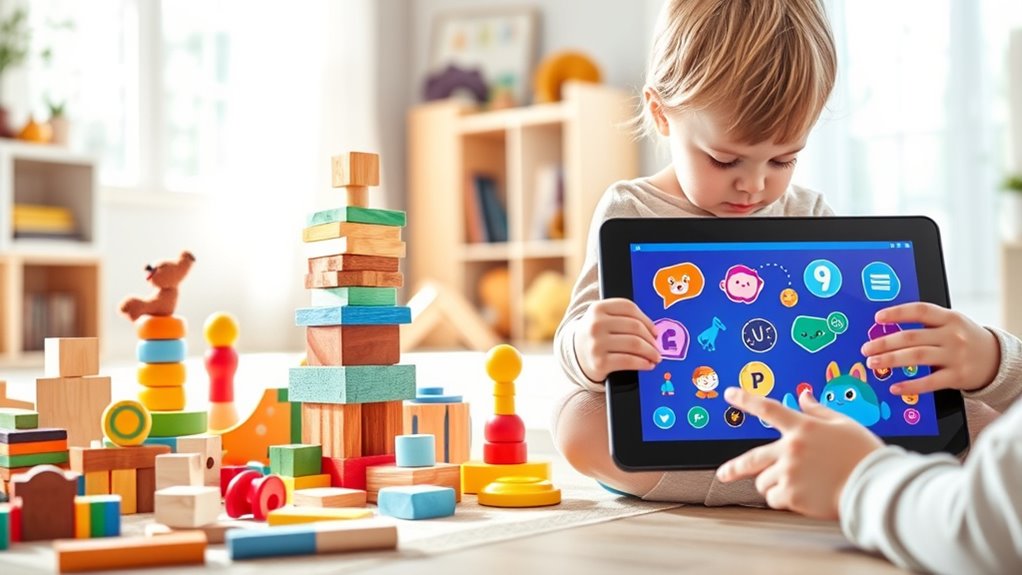

When choosing toys for preschoolers, consider balancing open-ended options like blocks and art supplies that boost creativity, with electronic toys that promote specific skills like memory and pattern recognition. Open-ended toys inspire imagination, problem-solving, and social interaction, while electronic toys can introduce new concepts and support cognitive development. Both types play valuable roles in your child’s growth—if you want to learn more about how to combine them effectively, keep exploring your options.

Turn the school run and nap time into listening time
- Thousands of audiobooks, podcasts and originals
- Listen on your phone, tablet or Echo — also offline
- Cancel anytime
Key Takeaways
- Open-ended toys foster creativity, imagination, and problem-solving, while electronic toys often guide specific activities and limit open exploration.
- Open-ended toys develop motor skills, social skills, and emotional intelligence through imaginative and collaborative play.
- Electronic toys support cognitive skills like memory, pattern recognition, and early literacy but may restrict creative thinking.
- A balanced approach combining both types offers holistic development, utilizing toys to nurture creativity and cognitive growth.
- Observing a child’s interests helps determine when to emphasize open-ended or electronic toys for optimal learning.
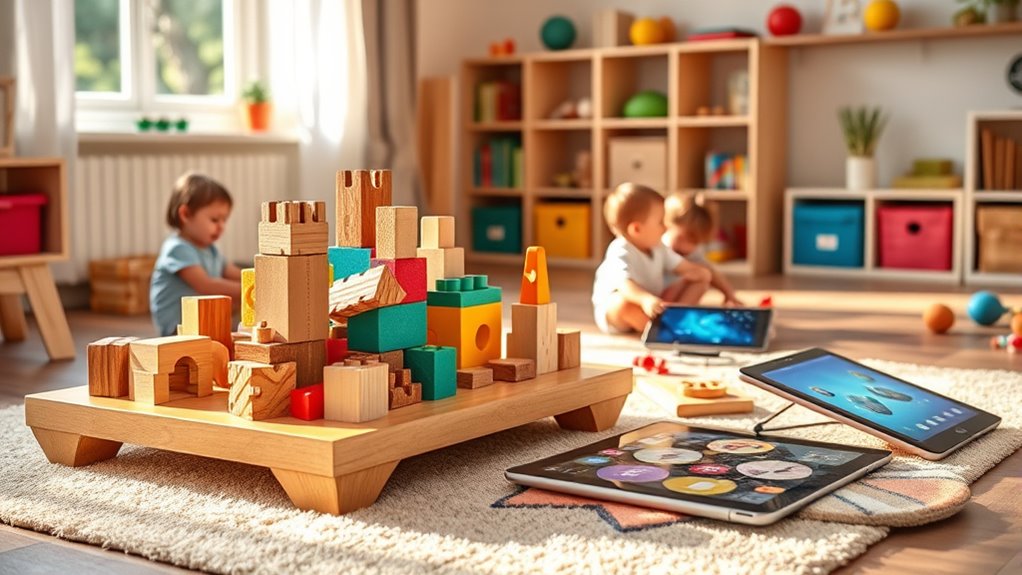
Choosing the right toys for preschoolers can considerably impact their development, and parents often face the choice between open-ended and electronic toys. When selecting toys, it’s essential to regard how they foster imaginative play and support skill development. Open-ended toys, such as building blocks, dolls, or art supplies, encourage your child’s creativity because they can be used in countless ways. These toys don’t have a fixed purpose, allowing children to imagine scenarios, invent stories, and experiment with different ideas. As they engage in imaginative play, they develop critical thinking, problem-solving skills, and emotional intelligence, all crucial for their growth.
On the other hand, electronic toys often come with features that aim to entertain and educate simultaneously. Many electronic options provide interactive experiences, such as learning games, musical toys, or tablets loaded with educational apps. While these toys can introduce new concepts quickly and make learning fun, they tend to limit open-ended exploration. Electronic toys often guide children toward specific activities, which might restrict their ability to use their imagination fully. If your goal is to promote flexible thinking and encourage your preschooler to invent their own stories and scenarios, open-ended toys are usually more effective.
Skill development is another critical aspect to regard. Open-ended toys promote fine and gross motor skills, spatial awareness, and social skills when children play together. For example, stacking blocks or assembling puzzles requires hand-eye coordination and patience. When children use their imagination during play, they also practice communication and cooperation, especially if they involve siblings or friends. Electronic toys can support skill development too but tend to focus more on cognitive skills like memory, pattern recognition, or early reading. However, because they often involve screens, it’s important to balance their use with more tactile, creative activities. Additionally, high-quality home theatre projectors can be an engaging tool for visual storytelling and educational entertainment when used appropriately.
Ultimately, the best approach is a balanced one. While electronic toys can introduce valuable learning opportunities, open-ended toys provide the foundation for creative thinking and adaptable skills. When you choose toys that stimulate imagination and promote skill development, you’re giving your preschooler tools to understand their world better. Your role is to observe what sparks their curiosity and to provide a variety of toys that challenge them to think, create, and grow in different ways. By combining both types thoughtfully, you can support your child’s holistic development while keeping playtime engaging and enriching.
Products Worth Considering

LEGO Boost Creative Toolbox 17101 Fun Robot Building Set and Educational Coding Kit for Kids

LEGO Art Hokusai The Great Wave Building Set (31208)

LEGO Star Wars Imperial Star Destroyer Building Toy – Build & Display Set for Ages 10+, Gift for Birthdays, Darth Vader & 6 Minifigures – 75
As an affiliate, we earn on qualifying purchases.
Frequently Asked Questions
How Do Open-Ended Toys Support Creativity in Preschoolers?
Open-ended toys support your preschooler’s creativity by encouraging imaginative play and exploration. They allow children to invent stories, scenarios, and solutions, which boosts their problem-solving skills. When kids use open-ended toys, they learn to think flexibly and develop their ideas without rigid instructions. This kind of play nurtures their natural curiosity and helps them build confidence in their ability to create and innovate independently.
Are Electronic Toys More Educational Than Open-Ended Toys?
You might wonder if electronic toys are more educational than open-ended ones. While electronic toys often feature technology integration, they can limit creativity and require less parental involvement. Open-ended toys, on the other hand, encourage imagination, problem-solving, and active play. Ultimately, the best choice balances technology use with hands-on, creative experiences, fostering development through both engaging learning and meaningful parental involvement.
What Safety Considerations Are There for Electronic Toys?
When considering electronic toys, safety is key. You should check for battery safety to prevent leaks or ingestion risks, and guarantee the batteries are securely enclosed. Also, watch out for choking hazards from small parts or removable batteries that little ones might swallow. Always follow age recommendations, supervise playtime, and choose toys made from non-toxic materials to keep your preschooler safe while enjoying their electronic toys.
How Do Play Preferences Differ Among Preschoolers?
You’ll notice preschoolers’ play preferences vary based on their interests and developmental stages. Some prefer active, imaginative play, while others enjoy quieter, focused activities. Toy durability is vital, as preschoolers often handle toys roughly. Parental involvement also shapes preferences—engaging with your child encourages exploration and helps you understand their favorite types of play, whether open-ended or electronic. Supporting diverse play styles fosters their creativity and skill development.
Can Open-Ended Toys Help Develop Social Skills?
Open-ended toys can definitely help develop social skills by encouraging sharing and fostering peer interactions. When you give preschoolers toys that invite imagination and collaboration, they learn to communicate, negotiate, and work together. These toys promote cooperative play, helping your child build essential social skills like patience, empathy, and teamwork. By engaging with open-ended toys, your child gains confidence in social settings and learns to enjoy group activities.
Conclusion
Did you know that children who play with open-ended toys tend to develop stronger creativity and problem-solving skills? Rather than relying solely on electronic toys, incorporating open-ended options encourages imagination and independent thinking. By choosing a mix of both, you give your preschooler the best of both worlds—fun and learning. So, consider balancing these toys to support your child’s growth, ensuring they develop essential skills while still having a blast.