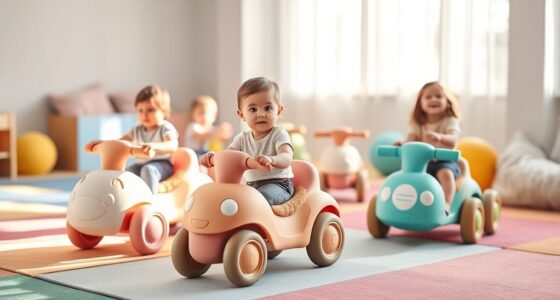
You can help children explore distance by using blocks during vehicle play. Encourage them to line up toy cars and compare different lengths by adding or moving blocks. This hands-on approach develops spatial awareness and estimation skills as they judge longer or shorter distances. As they build roads or bridges, ask questions about measurements to promote critical thinking. Keep going to discover more ways to make measurement fun and meaningful through play.

Turn the school run and nap time into listening time
- Thousands of audiobooks, podcasts and originals
- Listen on your phone, tablet or Echo — also offline
- Cancel anytime
Key Takeaways
- Using blocks to compare and estimate distances between vehicles enhances spatial awareness during play.
- Lining up toy cars along blocks helps children practice measuring and understanding length differences.
- Adjusting block lengths to match vehicle distances encourages critical thinking and measurement accuracy.
- Building roads and bridges with blocks introduces practical measurement concepts through creative construction.
- Visual perception and tactile assessment during block play develop intuitive measurement skills in a fun context.
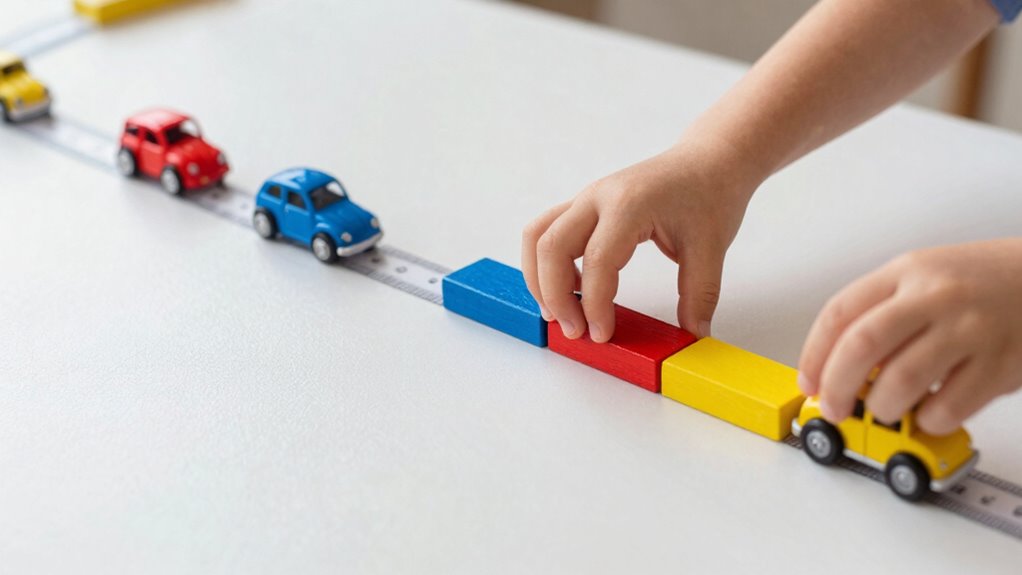
When children play with vehicles and blocks, they naturally begin to explore concepts of distance and measurement. You might notice them lining up toy cars along the edges of blocks or using blocks to create roads for their vehicles. This type of play isn’t just fun; it’s a valuable opportunity to introduce basic ideas of measurement and spatial awareness. As your child stacks blocks, they’re practicing block stacking, which helps develop fine motor skills and understanding of size relationships. When they then use these stacks to set up a road construction scene, they’re engaging in a form of measurement—determining how long a stretch of road should be or how many blocks are needed to connect two points.
Playing with vehicles and blocks helps children explore distance, measurement, and spatial awareness through fun, hands-on activities.
In these activities, you can encourage your child to compare distances by lining up cars along different lengths of blocks or across different stacked sections. They’ll start to see that some distances are longer or shorter and learn to use their eyes and hands to judge these differences. For example, as they build a bridge with blocks for their vehicles to cross, they’re actively measuring the length of the bridge needed, which enhances their understanding of size and scale. When they move cars from one end of their block structure to another, they’re practicing estimating and comparing distances, which are foundational skills in measurement.
Road construction play is especially effective for teaching distance because it combines creativity with practical measurement. You can guide your child to create a cityscape using blocks and then decide where to put roads or pathways. Ask questions like, “How many blocks long should this road be?” or “Can you make this stretch longer or shorter?” This prompts them to think critically about measurement and helps develop their estimation skills. As they build and adjust their construction, they learn that different distances require different amounts of blocks, fostering an intuitive sense of measurement. Developing a sense of measurement accuracy is fundamental for understanding how to compare and quantify distances effectively. Additionally, introducing spatial awareness during these activities helps your child understand how objects relate to each other in space, which is essential for developing overall measurement skills. Furthermore, understanding the connection between visual perception and measurement can improve their ability to judge distances more precisely.
Throughout these activities, you’re helping your child connect the abstract idea of measurement with concrete play. Whether stacking blocks to build a tower or laying out a road construction site, they learn that measurement isn’t just about numbers—it’s about understanding how objects relate to each other in space. This playful exploration lays a foundation for more complex skills later on, like using rulers or understanding scales. Recognizing that measurement is rooted in visual and hands-on assessment can make learning more accessible and engaging. By turning their play into a measurement adventure, you’re supporting their cognitive development while making learning engaging and hands-on.
As an affiliate, we earn on qualifying purchases.
Frequently Asked Questions
What Is the Ideal Age Range for Using Blocks to Measure Distance?
You should consider using blocks to measure distance with children aged 3 to 6 years old. At this age, their motor skills and understanding of measurement tools are developing, making blocks durable enough for repeated use. Younger children benefit from hands-on learning, while older ones can grasp basic measurement concepts. Always choose sturdy blocks that can withstand rough handling, ensuring they remain reliable measurement tools during play.
How Do Different Block Sizes Affect Measurement Accuracy?
Smaller blocks improve measurement precision because they allow you to measure more accurately and capture subtle changes in distance. Larger blocks can make measurement less precise, as they might skip over small gaps or details. When using different block sizes, you’ll find that smaller blocks give you finer detail, while larger blocks are easier to handle but less exact. Choose your block size based on the level of measurement accuracy you need.
Can This Method Be Used Outdoors or in Rough Terrains?
Sure, you can use this method outdoors, but don’t expect it to be smooth sailing—literally. Outdoor challenges and rough terrain considerations might make lining up blocks tricky, especially on uneven ground. Wind can shift your blocks, and dirt or grass can obscure your measurements. So, while it’s possible, be prepared for some extra patience and steady hands if you want accurate results in these unpredictable environments.
What Safety Precautions Should Be Taken During Play?
You should always prioritize safety during play by following supervision guidelines and ensuring proper block safety. Keep a close eye on children to prevent choking hazards or trips over blocks, especially outdoors or on rough terrain. Use age-appropriate blocks, and teach kids how to handle them safely. Regularly inspect blocks for damage, and encourage gentle play. These precautions help create a safe environment where kids can enjoy vehicle play and learning.
How Can This Activity Be Adapted for Children With Special Needs?
You can adapt this activity for children with special needs by incorporating sensory considerations and using adaptive strategies. For example, choose textured or brightly colored blocks to engage different senses, and modify the distance measurement approach to suit their motor skills. You might also use visual cues or tactile markers to help them understand distances better. These adjustments guarantee every child actively participates and benefits from the activity.
Conclusion
By using blocks to measure distances during vehicle play, you turn a simple activity into a fun learning experience. You help children develop their spatial awareness and counting skills effortlessly. Isn’t it amazing how something as straightforward as blocks can make learning so engaging? So next time you’re playing with your kids, why not incorporate measuring with blocks? It’s a small step that can lead to big discoveries and a love for learning.
Halloween Picks
halloween
As an affiliate, we earn on qualifying purchases.