Exploring gravity with ramps and slopes shows how the force pulls objects downward regardless of mass. When you slide objects on different slopes, they’ll accelerate at the same rate if friction is ignored, thanks to gravity’s influence. The steeper the slope, the faster they go. While mass affects how much force objects exert, it doesn’t change their acceleration. If you keep exploring, you’ll uncover how gravity shapes motion everywhere around you.
Key Takeaways
- Gravity causes objects to accelerate down ramps regardless of their mass.
- Steeper slopes increase the component of gravitational force, leading to faster acceleration.
- All objects on the same incline experience the same acceleration due to gravity, ignoring friction.
- The difference between mass and weight explains how gravity influences objects on slopes.
- Friction modifies expected motion, affecting how objects slide or roll down ramps.
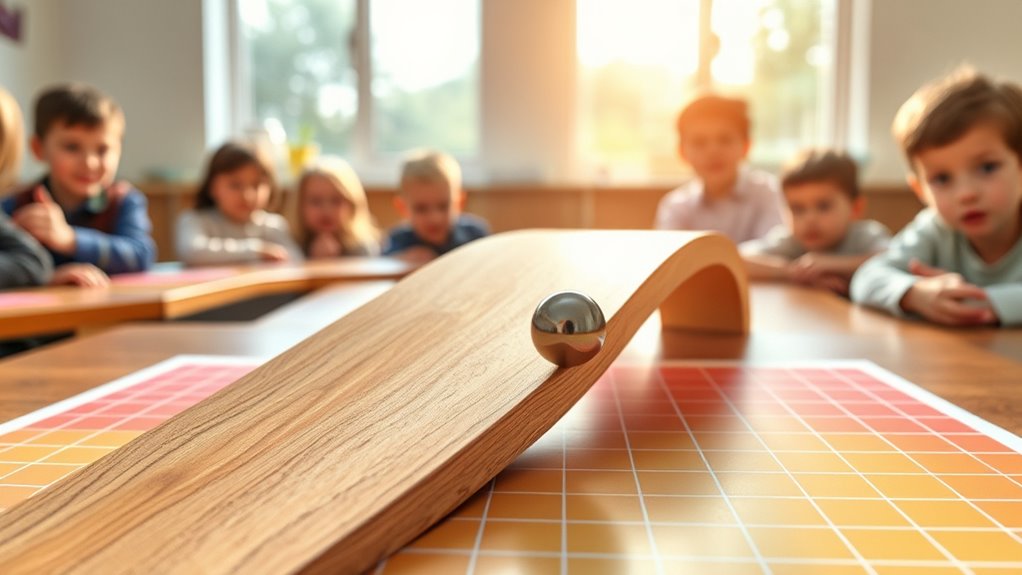
Have you ever wondered what keeps planets in orbit or causes objects to fall to the ground? The answer lies in gravity, a force that pulls objects toward each other. When exploring gravity with ramps and slopes, it’s helpful to understand the difference between mass and weight. Mass is the amount of matter in an object, which stays constant regardless of where you are. Weight, on the other hand, depends on gravity; it’s the force exerted on that mass by gravitational acceleration. For example, on Earth, your weight is the product of your mass and the gravitational acceleration, which averages about 9.8 meters per second squared. This means that if you have a mass of 10 kilograms, your weight is roughly 98 Newtons. But if you take that same object to the Moon, where gravitational acceleration is weaker, your weight decreases even though your mass remains the same.
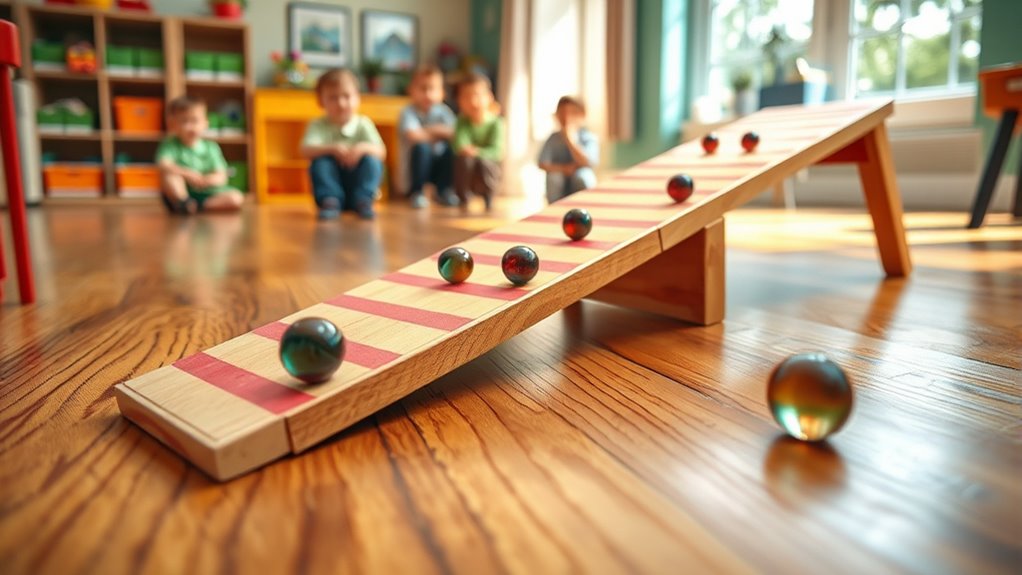
When you set up ramps and slopes to study gravity, you’re fundamentally examining how gravitational acceleration influences motion. The steeper the slope, the more gravity pulls objects downward, increasing their acceleration as they slide or roll. You can compare how objects with different masses behave on the same slope. You’ll notice that regardless of their mass, objects tend to accelerate at the same rate down the incline, which is a direct result of gravitational acceleration. This is because, in the absence of friction, all objects experience the same acceleration due to gravity, confirming that weight (a force dependent on mass and gravity) influences the force acting on objects, but not their acceleration. Additionally, understanding the role of friction helps explain why real-world objects may behave differently on slopes.
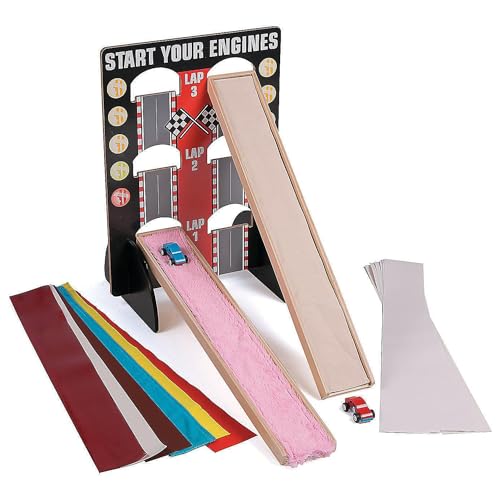
Fun Express STEM Motion & Friction Science Kit for Kids Age 5-12 – 21 Piece Educational Learning Resources with Wooden Ramp | Physics Engineering Toys for Classroom & Homeschool Experiments
Complete physics learning kit: Explore motion and friction concepts with 21 high-quality pieces including adjustable wooden ramp, test…
As an affiliate, we earn on qualifying purchases.
As an affiliate, we earn on qualifying purchases.
Frequently Asked Questions
How Does Gravity Vary on Different Planets?
You notice gravity varies on different planets because planetary density influences gravitational acceleration. On planets with higher density, like Mercury, gravity is stronger, making you feel heavier. Conversely, on less dense planets like Mars, gravity is weaker, so you feel lighter. Gravitational acceleration depends on planetary density and size, meaning each planet’s gravity differs based on its composition and mass. This variation affects how objects move and how you experience weight across the solar system.
Can Ramps Be Used to Measure Gravitational Differences?
Yes, you can use ramps to measure gravitational differences through mass measurement and acceleration analysis. By observing how objects accelerate on ramps with different inclines, you can compare the gravitational pull in various environments. Measuring the acceleration allows you to analyze differences in gravity, as a stronger gravity results in faster acceleration. This method provides a practical way to explore variations in gravity across locations or planets.
What Materials Best Demonstrate Gravity’s Effects?
You should use materials like metal balls, wooden blocks, or marbles to demonstrate gravity’s effects effectively. These materials allow you to measure mass accurately and observe how gravitational acceleration impacts their motion. By rolling or dropping them, you can see how gravity influences their speed and trajectory, making the concept clear. Their consistent mass and behavior make them ideal for hands-on experiments about gravitational forces.
How Does Friction Influence Ramp Experiments?
Imagine friction as the stubborn friend that slows everything down. In ramp experiments, frictional force depends on surface texture—rougher surfaces create more resistance, while smoother ones reduce it. This force impacts how objects roll or slide, affecting their speed and distance. So, if you want to see gravity’s true effect, choose surfaces with minimal friction. Otherwise, friction’s stubborn grip might hide gravity’s full influence on your experiment.
Are There Safety Concerns When Experimenting With Slopes?
Yes, there are safety concerns when experimenting with slopes. You should always follow safety precautions, like wearing protective gear and ensuring the area is clear. Conduct risk assessments beforehand to identify potential hazards, such as falling objects or slips. Keep the slope stable and secure, and supervise the experiment closely. Taking these steps helps prevent accidents and keeps everyone safe while exploring gravity with ramps and slopes.

National Geographic Junior Chemistry Set – Complete Early Learning Lab Kit with 50 Science Experiments for Kids and 20+ Lab Tools, Chemistry Set, Science Experiments for Kids 4-6
A COMPLETE CHEMISTRY LAB FOR YOUNG SCIENTISTS – Perfectly crafted for budding scientists aged 4 and up, this…
As an affiliate, we earn on qualifying purchases.
As an affiliate, we earn on qualifying purchases.
Conclusion
As you watch the marble glide down the ramp, feel how gravity’s invisible pull shapes your world, pulling everything toward its core. The gentle roll mirrors life’s inevitable journeys—sometimes smooth, sometimes bumpy—but always guided by unseen forces. Remember, just like the slope determines the marble’s speed, your choices steer your path. Embrace gravity’s quiet power, and let it remind you that beneath every surface, unseen forces shape your destiny, pulling you forward into the unknown.

Learning Resources STEM Explorers Magnet Movers – Science For Kids Sensory Bin, Critical Thinking, Fine Motor Toys, Classroom Math Supplies, Homeschool Crafts, Educational Games, Birthday Gift
HANDS-ON STEM LEARNING – Introduces children to magnetism through interactive exploration that captivates their curiosity and builds critical…
As an affiliate, we earn on qualifying purchases.
As an affiliate, we earn on qualifying purchases.

Teyva Daily 3 Pcs Inclined Plane Physics Teaching Kit – Simple Machines Classroom Teaching Tool with Dynamics Car and Wooden Block for Stem Science Lab Demonstration
3 Pcs Inclined Plane Physics Kit: our inclined plane set makes core physics concepts tangible; The kit includes…
As an affiliate, we earn on qualifying purchases.
As an affiliate, we earn on qualifying purchases.