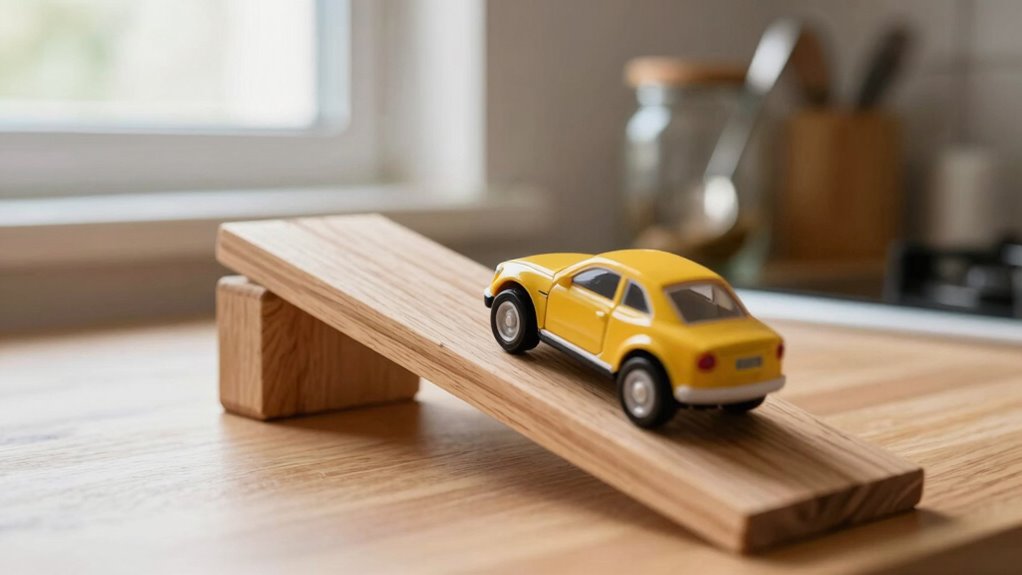

You can easily set up simple ramp experiments using household items like a sturdy book or small box as a ramp and objects like toy cars or smooth balls to test motion. Change the ramp’s steepness and try different surface textures like cloth or sandpaper to see how friction and gravity affect speed. These straightforward experiments help you explore physics concepts in a fun, hands-on way. Keep exploring to discover even more about how objects move!

Turn the school run and nap time into listening time
- Thousands of audiobooks, podcasts and originals
- Listen on your phone, tablet or Echo — also offline
- Cancel anytime
Key Takeaways
- Use household items like books or boxes to create ramps at different angles for simple experiments.
- Test various objects such as balls or toy cars to observe how ramp steepness affects speed.
- Change ramp surface materials (cloth, plastic, sandpaper) to explore friction’s impact on motion.
- Adjust the incline and surface type to see how gravity and friction interact to influence speed.
- Analyze how material properties and surface textures affect object movement in easy, practical experiments.
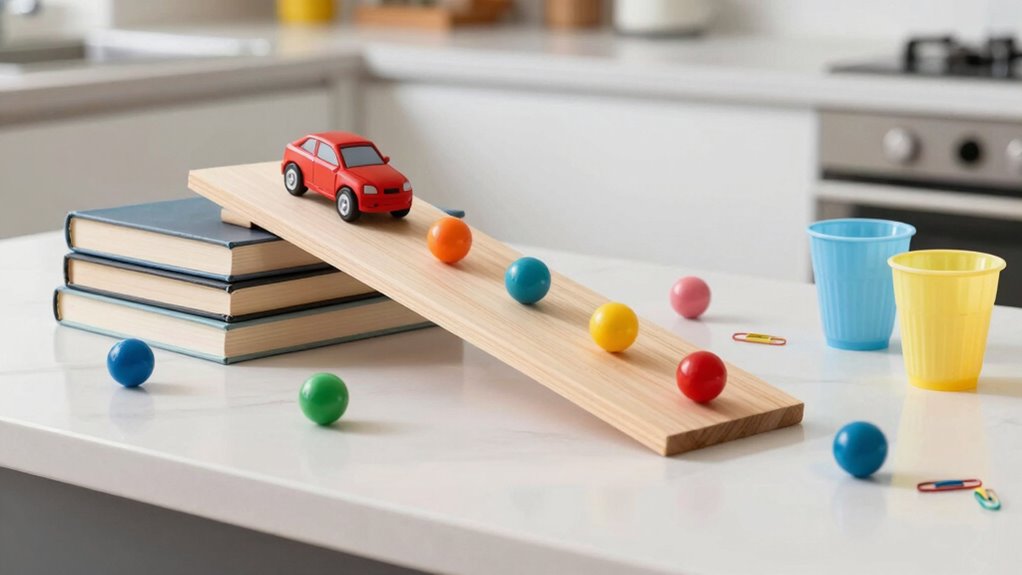
Have you ever wondered how ramps work and how to explore their physics easily? It’s a fascinating topic that combines basic principles like gravity effects and surface friction, and you don’t need fancy equipment to get started. With just household materials, you can set up simple experiments that reveal how these forces influence motion. Understanding how gravity pulls objects downhill and how surface friction resists that movement is key to grasping the physics behind ramps.
To begin, gather a few household items such as a sturdy book or small box to serve as a ramp, a smooth ball or toy car, and some different materials to create varied surfaces—think a cloth, sandpaper, or a piece of plastic. Position the ramp at different angles to see how the steepness affects the speed of the object rolling down. When you release the ball from the top, you’ll notice that gravity effects come into play: the steeper the ramp, the faster the object accelerates. This simple setup demonstrates how gravity constantly pulls objects downward, increasing their speed as they descend.
Surface friction plays a significant role in how smoothly or slowly the object moves. If you roll the ball on a smooth plastic surface, it glides easily, showing minimal friction. But if you switch to sandpaper or a rough cloth, the movement slows down noticeably. This change highlights how surface friction opposes motion, making it harder for the object to keep moving at the same speed. By experimenting with different surface materials, you can see firsthand how friction influences the velocity and overall motion on ramps.
Adjusting the angle of your ramp also helps you explore the interplay between gravity effects and surface friction. A steeper incline increases the component of gravity acting along the surface, speeding up the object, but if the surface is rough, friction might counteract some of that acceleration. Conversely, a gentle slope with a slick surface results in slower movement. These observations reinforce the idea that both gravity effects and surface friction work together to determine how objects move on ramps. Recognizing the physics concept behind these experiments helps deepen your appreciation for everyday phenomena and encourages further exploration.
In addition, observing how different materials affect the motion can also introduce you to the concept of surface properties, which influence friction and, consequently, the behavior of objects on inclined planes. Understanding these material interactions can help you better grasp how real-world ramps and slides are designed for safety and efficiency. Furthermore, exploring how different combinations of materials can alter the motion helps illustrate the importance of material science in engineering and design. Understanding these principles can help you better grasp how real-world ramps and slides are designed for safety and efficiency. Not only does this make learning engaging, but it also shows that exploring physics can be as straightforward as using everyday household items.
As an affiliate, we earn on qualifying purchases.
Frequently Asked Questions
How Do Ramps Help Us Understand Gravity?
Ramps help you understand gravity effects by showing how objects accelerate when moving down an incline. As you change the incline angles, you see how gravity influences the speed and motion of objects. The steeper the ramp, the stronger the gravity effects, causing faster acceleration. This hands-on experience helps you grasp how gravity works on different surfaces and angles, making the concept clearer and more tangible.
Can Ramps Be Used to Test Different Materials?
Think of a ramp as a playground for testing materials, like trying out different shoes on a slippery slide. You can definitely use ramps to test material variations by observing how easily objects slide down, which reveals surface friction. Different surfaces, like fabric or plastic, create unique experiences, helping you understand which materials have more grip or glide. It’s a fun way to see physics in action with everyday household items.
What Safety Precautions Should I Take?
You should always wear safety gear, like goggles and gloves, to protect yourself from potential hazards during ramp experiments. Make certain the area is clear of obstacles, and handle materials carefully. Supervision is needed if children are involved to ensure they follow safety rules. Always test ramps on stable surfaces and avoid rushing. Taking these precautions helps prevent accidents and ensures your experiment stays safe and fun.
How Can I Measure the Speed of Objects on a Ramp?
To measure the speed of objects on a ramp, start with velocity measurement by timing how long it takes for the object to travel a set distance. Use simple timing techniques like a stopwatch or a smartphone timer for accuracy. Record the time, then divide the distance by the time to find the velocity. Repeating the process guarantees more reliable results and helps you understand how different factors affect the object’s speed.
Are There Specific Household Items Best for Ramps?
Imagine turning your kitchen into a playground of discovery. Household tools like books, cardboard, or plastic bottles serve as perfect DIY models for ramps. They’re versatile, easy to set up, and can mimic real-world slopes. These household items are your treasure trove for experiments, giving you a simple, accessible way to explore physics. With a little imagination, everyday objects become gateways to learning and fun.
Conclusion
Now that you’ve explored these simple ramp experiments, you’re ready to uncover the secrets of gravity and motion right at home. Just like Galileo’s legendary experiments, you can have fun testing how different objects slide down ramps and learning how angles affect speed. So, grab your household materials and start experimenting—who knows, maybe you’ll invent the next great scientific discovery! Remember, even in modern times, curiosity and a little bit of old-fashioned wonder can take you far.
Halloween Picks
halloween
As an affiliate, we earn on qualifying purchases.