Doctor station and ambulance play provide a gentle, engaging way for you to help children explore healthcare helpers and build confidence. By role-playing with toy stethoscopes, bandages, and emergency scenarios, kids learn about medical roles while developing communication and problem-solving skills. These activities also help reduce fears about healthcare, promote emotional resilience, and foster teamwork. If you keep exploring, you’ll discover more ways to make these play activities both fun and educational for your child.

Turn the school run and nap time into listening time
- Thousands of audiobooks, podcasts and originals
- Listen on your phone, tablet or Echo — also offline
- Cancel anytime
Key Takeaways
- Promotes understanding of healthcare roles through realistic doctor and ambulance play scenarios.
- Develops communication, empathy, and problem-solving skills in a safe, engaging environment.
- Reduces anxiety about medical visits by familiarizing children with healthcare tools and procedures.
- Encourages teamwork and collaboration when playing as helpers in emergency situations.
- Builds confidence and practical life skills for handling emergencies and health-related situations.
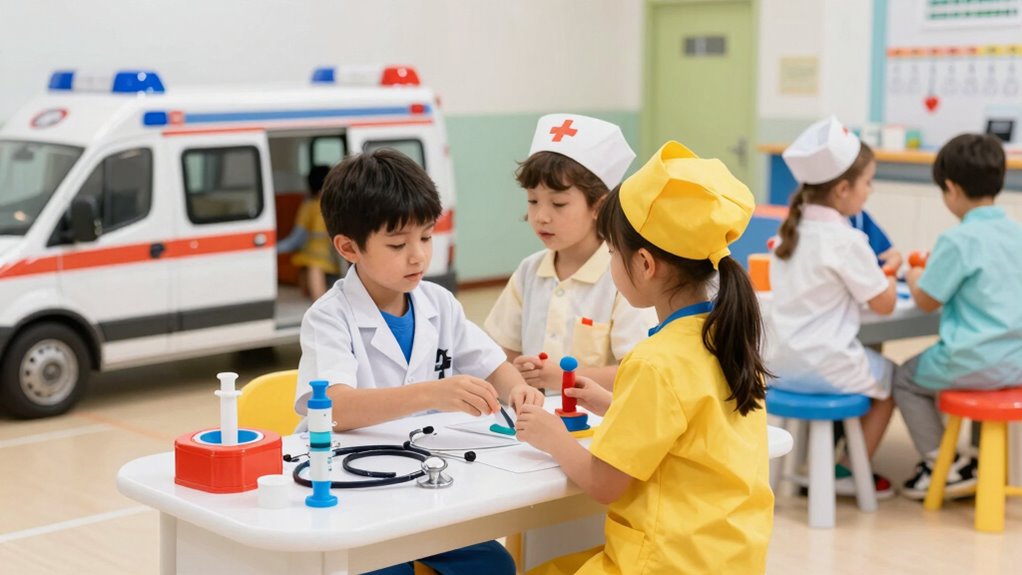
Have you ever wondered how playing doctor stations and ambulance games can boost your child’s imagination and social skills? When your child engages in medical role play, they step into the shoes of healthcare providers, imagining themselves as doctors, nurses, or paramedics. This kind of play helps them understand what these helpers do, fostering curiosity about health and safety. It also encourages creative thinking, as they invent scenarios and solutions in their pretend world. Through these activities, your child learns to communicate, ask questions, and develop empathy—skills that transfer to real-life interactions.
Playing with doctor stations often involves role-playing medical procedures, which introduces them to the concept of health care in a gentle, approachable way. They might use toy stethoscopes, bandages, and syringes, mimicking doctor-patient interactions. When you incorporate emergency scenarios into their play, it becomes an opportunity to teach them about safety and quick thinking. For example, they might pretend to respond to a fallen friend or a sick doll, practicing how to assess a situation calmly and act accordingly. These scenarios help demystify emergencies, making your child less anxious about real-life situations and more confident in their ability to respond.
Role-playing medical procedures helps children understand health care and builds confidence in emergency situations.
Emergency scenarios, in particular, serve as an excellent platform for teaching problem-solving and decision-making. As your child navigates these pretend crises, they learn to prioritize actions, communicate clearly, and collaborate with others if playing with siblings or friends. These kinds of games also promote patience, as they learn to listen and follow steps carefully. Additionally, understanding how emergency response works can help children feel more secure and prepared in actual situations. Moreover, playing such scenarios can foster an awareness of the importance of community helpers in maintaining safety and health in society. Furthermore, they develop an understanding of community helpers’ roles, recognizing that doctors and paramedics are there to keep everyone safe. Engaging in these role-plays can also help children develop emotional resilience, as they learn to cope with different situations in a controlled environment. Exploring medical environments through play can also help children feel more comfortable during actual doctor visits, reducing fear and anxiety. Including simulated emergencies in play can teach children how to stay calm and focused during stressful situations, which is an essential life skill.
Engaging in medical role play and emergency scenarios also offers an emotional outlet. If your child is anxious about visiting the doctor or seeing an ambulance, acting out these situations at home can reduce their fears. It gives them a sense of control and familiarity, easing any apprehension. Plus, it’s a fun way to bond, as you participate in their imaginative worlds, encouraging them to express their feelings and ask questions.
Products Worth Considering

LEGO Boost Creative Toolbox 17101 Fun Robot Building Set and Educational Coding Kit for Kids

LEGO Icons Tranquil Garden Building Set – Japanese Zen Garden DIY Kit for Adults, 10315

LEGO Marvel Iron Man Mark 3 Collector’s Edition Building Set (76344)
As an affiliate, we earn on qualifying purchases.
Frequently Asked Questions
What Skills Do Children Develop Through Doctor and Ambulance Play?
Through doctor and ambulance play, you help children develop medical empathy and role differentiation. They learn to understand others’ feelings, especially when caring for pretend patients, fostering compassion. Kids also practice distinguishing roles—doctor, nurse, patient, paramedic—enhancing social understanding. This active play boosts their communication skills, problem-solving, and confidence, making complex concepts approachable while nurturing a caring attitude and the ability to recognize different helpers in real life.
How Can Parents Ensure Safety During Role-Playing Activities?
Safety during role-playing activities is your top priority, and you can easily attain it by following clear safety guidelines and supervision strategies. Always stay close to supervise your child, set boundaries, and use age-appropriate toys. Regularly check the play area for hazards, and encourage gentle play. By actively guiding and monitoring, you guarantee a safe environment where your child’s imagination flourishes without risking their safety—making playtime both fun and secure.
What Are Recommended Age Ranges for Ambulance and Doctor Station Toys?
You should choose ambulance and doctor station toys suitable for children aged 3 to 7 years. At this age, kids can safely engage in role-playing with a medical kit, helping them understand helpers and health concepts. Make certain the toys have rounded edges, are made of non-toxic materials, and are easy to handle. This way, your child can enjoy learning through imaginative play while staying safe and engaged.
How Can These Play Activities Be Adapted for Children With Special Needs?
Remember, “Every child is different,” so you should tailor play activities to their needs. For children with special needs, incorporate sensory accommodations like soft textures or noise-reducing headphones, and use communication adaptations such as picture cards or visual cues. These adjustments make the play accessible and engaging, helping children feel comfortable while exploring helpers. Your patience and creativity can turn play into a meaningful, inclusive experience for every child.
Are There Any Educational Benefits Beyond Healthcare Awareness?
You can discover that these play activities offer more than healthcare awareness; they help children grasp medical terminology and develop emotional understanding. By role-playing as helpers, children learn to express feelings about health and safety, building empathy and communication skills. This engaging approach encourages curiosity about health concepts and fosters emotional growth, making learning both fun and meaningful for children, especially when you adapt activities to their individual needs.
Conclusion
As you watch your little one immerse themselves in doctor station and ambulance play, you realize these moments do more than entertain—they reveal their future helpers. But what if these playful scenarios are just the beginning? Behind every bandage and siren lies a potential hero-in-the-making, waiting for the right moment to step into real-life action. Are you ready to nurture their emerging skills and see where their imagination could take them? The adventure is just beginning.