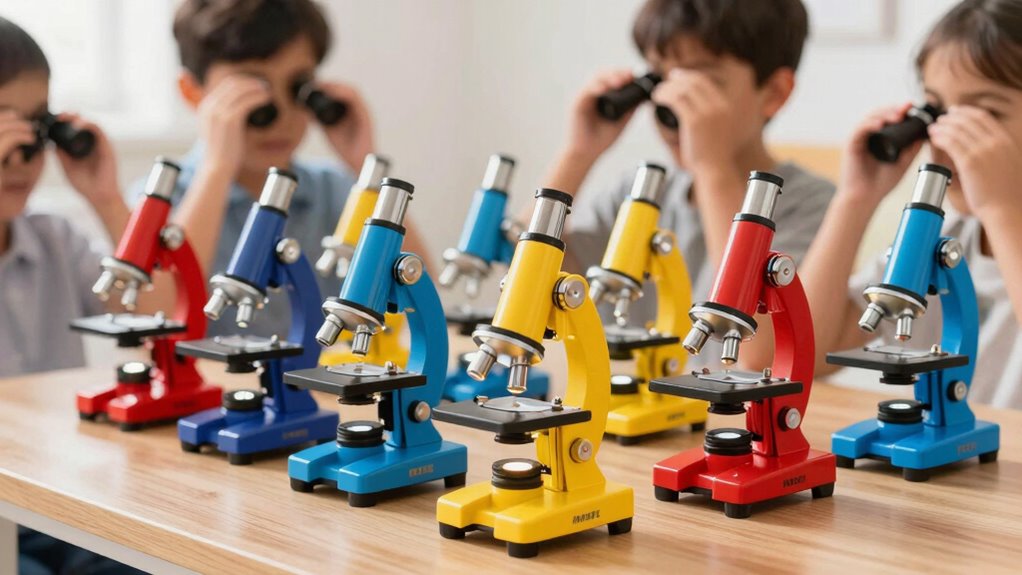

For most families, the 58-Piece Kids Microscope Kit with a metal body is the best overall starting point because it pairs a traditional microscope format with useful supplies and a carrying box. The National Geographic Dual LED Microscope is a strong choice for school-age children who want hands-on slide viewing, while a handheld digital microscope with a built-in screen better suits kids who want to explore objects without preparing slides. The main tradeoff is between classic optics and slide-based learning, portable digital viewing, and how much setup a child can manage. Included accessories can help a beginner get started, but they matter less if the microscope is difficult to focus or awkward to hold. Read on for the full breakdown of all 15 options and guidance on choosing the right style.

Turn the school run and nap time into listening time
- Thousands of audiobooks, podcasts and originals
- Listen on your phone, tablet or Echo — also offline
- Cancel anytime
Complete the kit


Key Takeaways
- The lineup splits into two distinct experiences: compound microscopes teach slide preparation and traditional focusing, while handheld digital models make it easier to inspect objects on a screen.
- The 58-piece metal-body kit stands out for a more complete classic setup; the National Geographic dual-LED model is a more focused alternative for children ready to work with slides.
- Screen size and handheld portability are separate strengths. Models with 2.4- or 4-inch screens may be easier to share, while smaller-screen options are easier to carry.
- Magnification claims do not tell the whole story. Lighting, focus control, working distance, and the object being viewed can matter more to a child’s success than the largest stated number.
- Age fit depends on the activity, not just the label. Younger children may prefer guided, screen-based exploring or a talking microscope, while older beginners may get more from a compound model and prepared slides.


| microscope kid | Magnification | Lighting |
|---|---|---|
| Kids Microscope Kit with 61 Pi | 100X–1200X | LED light |
| 4K 1000X Handheld Digital Micr | 200X–1000X | 8 LEDs with 3 brightness levels |
| Odatay 4K 1000X Digital Micros | 200X–1000X | 8 LEDs with adjustable brightness |
| Kids Microscope | Up to 1000X | 8 adjustable LEDs |
| 4.0-inch Handheld Microscope f | 100X–1600X | 8 adjustable LEDs |
| Odatay 1000X Digital Kids Micr | 100X–1000X | — |
| Kids Digital Microscope STEM T | 200X–1000X | — |
| Educational Insights GeoSafari | — | — |
| 1000X Digital Handheld Microsc | 100X–1000X | — |
| 58-Piece Kids Microscope Kit | 100X–1200X | — |
| 1000X Handheld Digital Microsc | 1000X | 8 adjustable LEDs |
| PalliPartners Compound Microsc | 100X to 2000X | — |
| National Geographic Microscope | — | LED above and below |
| Handheld Digital Microscope fo | 200X–1000X | — |
| National Geographic Dual LED M | 20X and 50X | Dual LED |
More Details on Our Top Picks
Kids Microscope Kit with 61 Pieces, LED Light, and Carrying Case
For kids who want to prepare and inspect specimens rather than just point a camera at whatever is nearby, this 61-piece kit offers a more traditional start than the handheld digital models in this group. Its 100X–1200X magnification, prepared and blank slides, and included tools give children several ways to practice observation, while the carrying case keeps the pieces together between sessions. Compared with the Odatay 4K 1000X Digital Microscope, this set puts more emphasis on slide work and tools than on a screen, camera, and stored images. That makes it a better fit for guided science activities, but less convenient for outdoor exploring or sharing views with several people. The number of components may also call for adult help with setup, especially for younger children.
Pros:- Includes prepared and blank slides for both immediate viewing and practice.
- 61-piece set supplies tools alongside the microscope.
- Carrying case helps keep small parts together and supports portability.
- 100X–1200X range offers several magnification settings for guided exploration.
Cons:- More pieces and setup steps may require adult supervision for younger children.
- Does not list a built-in screen or camera for easy group viewing and recording.
- Its feature set is aimed at introductory learning rather than advanced microscopy.
Best for: Families with children ages 6–12 who want a slide-based science activity with tools and a case for organized storage.
Not ideal for: Young children who need a simple, screen-based viewer, or families who want to capture and replay images without a separate device.
- Magnification:100X–1200X
- Pieces:61
- Lighting:LED light
- Included materials:Prepared and blank slides, tools, carrying case
- Model:SD668
- Brand:Mileonaim
- Intended age range:6–12 years
- Warranty:2 years
Our verdict“Choose this kit for slide-centered science sessions and included accessories, but pick a digital handheld model if easy viewing and recording matter more.”
4K 1000X Handheld Digital Microscope for Kids with 2.0″ IPS Screen (Blue)
This handheld model suits families who want a child to inspect small objects directly on a built-in display, without the slides-and-tools setup of the Mileonaim 61-piece kit. Its 2.0-inch screen, 200X–1000X magnification, and photo and video functions make the viewing experience feel more immediate; the 8 LEDs with three brightness levels help adjust illumination as the subject changes. At 0.5 pounds, it is portable, though the Odatay model in this batch is lighter and has a larger 2.4-inch screen plus a 32GB card. This microscope’s simpler, compact format may suit younger users, but the description does not specify battery life, and USB power and file transfer mean it is less self-contained than a rechargeable option with stated runtime.
Pros:- Built-in 2.0-inch IPS screen lets children view subjects without a phone.
- Photo and video functions support saving observations.
- Eight LEDs offer three brightness settings for different subjects.
- Lightweight handheld design and included neck strap support portable use.
Cons:- The 2.0-inch display is smaller than the 2.4-inch screen on the Odatay model.
- Battery life is not specified, making session planning less predictable.
- USB power and file transfer may limit use away from a suitable connection.
Best for: Families seeking a straightforward digital microscope for children who want to view and record small objects without preparing slides.
Not ideal for: Buyers who want a larger display, confirmed battery runtime, or a memory card included for saving images.
- Magnification:200X–1000X
- Screen:2.0-inch IPS
- Camera:4K HD
- Lighting:8 LEDs with 3 brightness levels
- Weight:0.5 lb
- Power source:USB
- Photo and video:Supported
- Intended age range:3–12 years
Our verdict“Pick this for compact, screen-based exploration, but choose the Odatay if a larger display and included storage card are priorities.”
Odatay 4K 1000X Digital Microscope for Kids with 32GB Card, Long Distance Viewing & 2.4″ Screen, Portable Handheld Educational Toy for Ages 3-12, Blue
The Odatay combines a handheld format with a useful bundle for kids who want to take microscope-style viewing beyond a desk. Its 2.4-inch display is larger than the 2.0-inch screen on the other handheld 4K model here, and the included 32GB TF card gives families storage for captured observations from the outset. Prepared slides, a lanyard, and silicone case add options for both indoor practice and carrying it outside. Compared with the Kids Microscope 4K 1000X Zoom, Odatay includes a memory card and more listed accessories, while that alternative specifies a two-hour runtime and internal photo storage. Odatay’s battery-powered design is portable, but its runtime is not given; younger children will also need supervision around the small accessories.
Pros:- 2.4-inch screen provides more viewing area than the 2.0-inch handheld model.
- Included 32GB TF card provides room to save photos and videos.
- Prepared slides, lanyard, slide cover, and silicone case support varied use and carrying.
- Lightweight design weighs 0.25 kg.
Cons:- Battery runtime and charging frequency are not specified.
- Small accessories may require careful supervision around younger children.
- The accessory bundle can add setup and storage work compared with a simpler handheld model.
Best for: Families who want a portable digital microscope for indoor and outdoor observation, with a larger screen and memory card included.
Not ideal for: Buyers who need a stated battery runtime, or caregivers seeking a simple, accessory-free toy for very young children.
- Magnification:200X–1000X
- Display:2.4-inch screen
- Camera:4K HD
- Memory card:32GB TF card included
- Lighting:8 LEDs with adjustable brightness
- Power source:3.7V battery
- Weight:0.25 kg
- Included accessories:Prepared slides, data cable, lanyard, slide cover, silicone case
Our verdict“Choose Odatay for portable digital viewing with a larger screen and card included, but favor the 4K 1000X Zoom model if stated runtime matters more.”
Kids Microscope, 4K 1000X Zoom, 2.4″ Screen, STEM Toy for Ages 4-8
Among the digital handheld choices here, this model is the clearest fit for caregivers who want a stated battery limit rather than an unspecified runtime. Its 600mAh rechargeable battery is listed for about two hours of use, and the 2.4-inch screen gives young users a larger viewing area than the 2.0-inch display on the blue handheld 4K model. Internal memory holds up to 200 photos, so a TF card is not required for basic image saving, though the card itself is not included. The eight adjustable LEDs help with illumination, while Type-C connectivity supports charging or transfer. Compared with Odatay’s digital microscope, this one provides a stated runtime and internal storage, but Odatay includes a 32GB card and more listed carrying accessories.
Pros:- Rechargeable battery has a listed runtime of about two hours.
- Internal memory stores up to 200 photos without a TF card.
- 2.4-inch display is larger than the 2.0-inch screen on the other handheld 4K model.
- Eight adjustable LEDs allow illumination to be changed for different subjects.
Cons:- Two hours of continuous use may not cover longer exploration sessions.
- TF card is not included for expanded storage.
- USB-C cable is required, and an adapter is not included.
Best for: Caregivers of children ages 4–8 who want a rechargeable handheld microscope with a stated runtime and basic photo storage built in.
Not ideal for: Families planning long outings between charges, or buyers who want an included TF card and accessories such as a lanyard and case.
- Magnification:Up to 1000X
- Screen:2.4 inches
- Lighting:8 adjustable LEDs
- Battery:600mAh rechargeable
- Runtime:About 2 hours
- Internal storage:Up to 200 photos
- Connectivity:Type-C USB
- Dimensions:4.13 × 3.74 × 2.6 inches
- Weight:150 g
Our verdict“Choose this for a rechargeable, self-contained starter experience, but pick Odatay if you want a memory card and carrying accessories in the box.”
4.0-inch Handheld Microscope for Kids, Digital Mini Pocket Microscope with 1600X Magnification
The standout here is the 4.0-inch IPS display, which gives children more room to inspect a live image than the 2.4-inch screens on both the Odatay and rechargeable 4K models. Its listed magnification reaches 1600X, higher than the 1000X ceiling of those handheld alternatives, and the included 8GB TF card offers a starting point for saving images. A built-in hotspot is also listed for sharing, adding a digital option that the other models do not specify. The tradeoff is a larger 7.4-inch-long body, which may be harder for smaller hands to hold steadily than the lighter Odatay. Its 1080P imaging is described separately from a 2MP camera, so buyers focused on camera resolution should compare those details rather than assume a higher magnification figure guarantees clearer images.
Pros:- 4.0-inch IPS display offers more viewing area than the 2.4-inch screens on the other handheld models.
- Magnification range reaches 1600X, above the 1000X maximum listed for the comparison models.
- Included 8GB TF card supports saving observations.
- Built-in hotspot is listed for sharing photos and videos.
Cons:- At 7.4 inches long, it may be awkward for younger children to hold steady.
- Camera is listed as 2MP with 1080P imaging, while competing handheld options advertise 4K HD.
- The product data is inconsistent about battery inclusion: it lists a battery in the specs but also says batteries are not included.
Best for: Families with children ages 3–8 who value a larger screen, onboard image storage, and sharing features for guided exploration.
Not ideal for: Buyers prioritizing a compact grip, a clearly specified battery-included package, or the higher listed camera resolution of the 4K models.
- Display:4.0-inch IPS
- Magnification:100X–1600X
- Imaging:1080P HD
- Camera:2MP
- Lighting:8 adjustable LEDs
- Power:Battery powered; product data lists 1 lithium-ion battery included
- Included storage:8GB TF card
- Dimensions:7.4 × 4.5 × 1.59 inches
- Materials:ABS, aviation aluminum alloy, metal, and plastic
Our verdict“Pick this if a larger screen and higher stated magnification matter most, but choose a smaller 4K handheld if portability and camera resolution lead your priorities.”
Odatay 1000X Digital Kids Microscope Kit with 12 Slides & 2-Inch Screen, Blue
I’d choose this Odatay for a child who is more likely to explore when specimens are ready to view. Its 12 included slides cover plants, vegetables, insects, and animals, giving a young learner a starting point before heading outside to find new subjects. The 2-inch screen and 1080P camera make it easier to share a view than a traditional eyepiece, while the rechargeable design supports portable use. Compared with the Kids Digital Microscope STEM Toy, it includes more slides, but that rival supplies a 32GB memory card and a carrying case. This Odatay’s main tradeoff is storage: a microSD card for expanded space is not included. Its small-hand design also makes it a less comfortable pick for older children.
Pros:- Includes 12 slides spanning plants, vegetables, insects, and animals
- 1080P camera records photos and videos
- Rechargeable battery supports portable exploration
- Connects to a PC
Cons:- MicroSD card for expanded storage is not included
- Small-hand design may feel cramped for older children
- The 2-inch screen offers less viewing area than larger-screen alternatives
Best for: Young children who want a screen-based microscope with a generous selection of prepared specimens and the option to explore outdoors
Not ideal for: Older children or families who want storage ready for lots of photos and videos without buying a memory card separately
- Magnification:100X–1000X
- Camera resolution:1080P
- Screen:2-inch IPS
- Included slides:12; plants, vegetables, insects, and animals
- Power:Rechargeable battery
- Connectivity:PC connectable
- Suggested age range:3–12
Our verdict“Choose this Odatay for a younger child who wants ready-made specimens and a portable digital view, but pick the Kids Digital Microscope STEM Toy if an included memory card and case matter more.”
Kids Digital Microscope STEM Toy: Complete Science Gift Kit for Ages 4-12
This kit has the clearest case for families who want a digital microscope that can travel with its accessories. The 32GB memory card is included, so a child can save photos and videos without first sourcing extra storage, and the EVA carrying case keeps the lightweight unit and supplies together. It comes with five real glass specimens, giving activities a more authentic slide-based feel than the screen-first approach of the 1000X Digital Handheld Microscope for Kids, which emphasizes built-in storage and adjustable LEDs instead. The tradeoff is a shorter stated runtime of about 2.5 hours, plus manual focus that may take practice for younger users. Image quality may also be limited at the highest magnifications, so the 1000X figure shouldn’t be read as a guarantee of fine detail.
Pros:- Includes a 32GB memory card for saving photos and videos
- EVA case makes the microscope and accessories easier to store and carry
- Five real glass specimens support hands-on slide activities
- Lightweight at 0.34 lb
Cons:- Approximately 2.5 hours of battery life may limit longer outings
- Manual focus can be challenging for some children
- Image quality may be limited at higher magnifications
Best for: Families seeking a portable digital microscope kit with included file storage, a protective case, and real glass specimens
Not ideal for: Children who need very simple focusing or families planning long sessions away from a charger
- Magnification:200X–1000X
- Memory card:32GB included
- Battery life:Approximately 2.5 hours
- Included specimens:5 real glass specimens
- Charging:Type-C charging cable
- Weight:0.34 lb
- Suggested age range:4–12
Our verdict“Pick this kit for portable, photo-friendly exploration with accessories in one case; choose the 1000X Digital Handheld Microscope for Kids if adjustable lighting and stated longer runtime are higher priorities.”
Educational Insights GeoSafari Talking Microscope
For preschoolers, I’d favor this over a conventional digital microscope when the goal is guided discovery rather than independent focusing or image capture. The GeoSafari presents 60 full-color images across 20 slides and adds fact and quiz modes, with voice guidance that can help keep a short learning activity moving. Its language options—English, Spanish, French, and German—also make it more adaptable for some households than the screen-and-camera microscopes in this lineup. By comparison, the Odatay 1000X Digital Kids Microscope lets children inspect specimens and save images, but asks them to manage a more hands-on viewing process. The GeoSafari’s limits are just as clear: it is designed for ages 3–5, and it runs on three AAA batteries that are not included. Children ready to find and focus their own samples may outgrow its guided format.
Pros:- Fact and quiz modes give young children guided ways to engage
- 20 slides provide 60 full-color images
- Voice guidance features Bindi Irwin
- Supports English, Spanish, French, and German
Cons:- Three AAA batteries are required and not included
- Designed for preschoolers, so older children may outgrow the activity
- Limited slide storage capacity may make organizing the slides less convenient
Best for: Preschool children who benefit from voice-guided facts, simple quizzes, and prepared visual material rather than manual microscope setup
Not ideal for: Older children who want to inspect their own specimens, adjust magnification, or capture photos and videos
- Slides:20 slides with 3 images each (60 images)
- Modes:Fact Mode and Quiz Mode
- Power:3 AAA batteries, not included
- Suggested age range:3–5
- Language options:English, Spanish, French, and German
- Warranty:1 year
Our verdict“Choose the GeoSafari for a preschooler who wants guided, spoken science activities; choose the Odatay 1000X Digital Kids Microscope when a child is ready to focus on real specimens and save images.”
1000X Digital Handheld Microscope for Kids Portable Outdoor Toys & Gifts
This handheld model suits children who want to inspect objects where they find them, rather than set up a collection of slides at a table. The 200g body, rechargeable battery, and built-in photo and video storage make it a practical grab-and-go option, while eight adjustable LEDs with four brightness levels help adapt illumination to different subjects. Its oversized textured focus wheel is a useful detail for children still developing fine-motor control. Compared with the Kids Digital Microscope STEM Toy, this model offers adjustable lighting and up to three hours of stated use, but the STEM kit provides a 32GB card and a case. The camera is 2MP, and expanded storage calls for an SD card that is not included. The claimed magnification range also does not by itself promise crisp detail at every setting.
Pros:- Lightweight 200g design is suited to handheld outdoor use
- Eight LEDs offer four brightness levels
- Oversized textured focus wheel is designed for easier adjustment
- Built-in storage supports photo and video capture
Cons:- 2MP camera resolution is modest compared with higher-resolution digital options
- SD card for additional storage is not included
- Up to three hours of battery use may require recharging during extended outings
Best for: Children ages 5–13 who want a lightweight handheld microscope for examining outdoor finds and saving images
Not ideal for: Families who need high-resolution image capture, an included expanded-storage card, or a protective carrying case
- Magnification:100X–1000X
- Camera resolution:2MP
- Display:2-inch HD color screen
- LED lighting:8 adjustable LEDs with 4 brightness levels
- Battery:600mAh rechargeable; up to 3 hours
- Connectivity:USB-C file transfer
- Weight and material:200g; BPA-free ABS plastic
Our verdict“Choose this model for lightweight outdoor viewing and adjustable lighting; pick the Kids Digital Microscope STEM Toy if an included memory card and carrying case are more useful.”
58-Piece Kids Microscope Kit – 100X-1200X Magnification, Metal Body, LED Light, Carrying Box for Kids Ages 5-12
Unlike the handheld digital models in this roundup, this kit centers on a traditional microscope setup with slides, specimens, and lab tools. That makes its 58-piece collection appealing for children who want a more structured table activity and a chance to handle microscope accessories, rather than simply point a screen at outdoor objects. The metal body and LED light add a more instrument-like feel than the plastic-bodied digital options, while magnification reaches 1200X. The tradeoff is that this is not the quick-share option: there is no listed camera or screen, so viewing is through the microscope itself. Compared with the GeoSafari Talking Microscope, it offers hands-on specimen work rather than narrated facts and quizzes, but it also requires more setup and uses two AA batteries, which are not included.
Pros:- 58-piece set includes prepared specimens, slides, and lab tools
- Traditional microscope format supports hands-on slide activities
- Metal body offers a sturdier instrument feel than many handheld plastic models
- LED illumination supports viewing without relying on ambient light
Cons:- Two AA batteries are required and not included
- No camera or screen is listed for sharing or saving observations
- Plastic components may feel less durable over time
Best for: Children ages 5–12 who want a traditional tabletop microscope kit with specimens and lab tools for guided activities
Not ideal for: Families who want a digital screen, simple photo sharing, or a low-setup handheld tool for outdoor exploration
- Magnification:100X–1200X
- Pieces:58
- Materials:Metal and plastic
- Light source:LED
- Dimensions:4.6 × 2.75 × 8.15 in
- Power:Battery powered; requires 2 AA batteries
- Suggested age range:5–12
Our verdict“Choose this kit for children who want a conventional microscope and a broad set of lab accessories; pick a digital handheld model if screen viewing and easy image capture matter more.”
1000X Handheld Digital Microscope for Kids with 2.0″ IPS Screen
For children who want to inspect objects without learning to use a traditional eyepiece, this handheld digital design keeps viewing straightforward: the image appears on its 2.0-inch screen, with eight adjustable LEDs to light the subject. Its 1000X magnification and 2MP camera support photo and video capture, though the stated magnification alone does not guarantee fine detail. At 200g, it is easier to carry outdoors than the PalliPartners compound microscope, which is better suited to a table and slide-based sessions. The tradeoff is a small display and roughly two hours of battery life, so it may frustrate children who want long sessions or a larger shared view. I’d choose it for brief, hands-on exploration, not as a replacement for a classroom-style compound microscope.
Pros:- Handheld format weighs 200g, making it easy to take outside
- Eight adjustable LEDs help illuminate different subjects
- Photo and video storage supports documenting discoveries
- Kid-oriented ABS casing is described as durable and shock-absorbent
Cons:- Battery lasts approximately two hours, limiting longer sessions
- The 2.0-inch screen can be cramped for group viewing
- Data transfer requires a USB connection
Best for: Young children and families who want a lightweight screen-based microscope for short indoor or outdoor explorations.
Not ideal for: Children who need a large shared display, extended battery life, or traditional slide-based instruction.
- Magnification:1000X
- Camera:2MP
- Display:2.0-inch IPS screen
- Lighting:8 adjustable LEDs
- Battery:600mAh; up to 2 hours
- Storage:32MB; stated capacity of 200+ photos/videos
- Material:ABS plastic
- Weight:200g
Our verdict“Choose this for portable, screen-based discovery with younger children, but pick a compound model for longer, more structured slide work.”
PalliPartners Compound Microscope for Adults & Students
This is the most classroom-oriented choice in this group: the compound microscope format, three objective lenses, and included slides give older children a more structured route into observing specimens. The listed range reaches 2000X, while top and bottom LEDs offer illumination for different kinds of samples. Compared with the National Geographic microscope capped at 400X, the PalliPartners offers a wider stated magnification range and a 28-slide starter set; compared with handheld digital picks, it asks for more patience and setup. The phone adapter and Bluetooth remote add a way to capture observations, but the controls and adjustments may be challenging for very young users without adult help. I’d favor it for supervised students who want hands-on slide practice, not for a preschooler seeking quick screen viewing.
Pros:- Compound format supports more structured slide-based observation
- Includes 28 slides, a phone adapter, and Bluetooth remote
- Top and bottom LED illumination suit different specimen setups
- Objective lenses provide several magnification options
Cons:- Setup and adjustments can be challenging for beginners
- May require adult supervision for younger children
- Less portable and spontaneous to use than handheld digital microscopes
Best for: School-age students with adult support who want to learn conventional slide preparation and microscope focusing at home.
Not ideal for: Very young children or families seeking a simple handheld microscope with minimal setup and immediate screen viewing.
- Magnification:100X to 2000X
- Objective lenses:4X, 10X, and 40X
- Eyepiece:WF25X
- Additional lens:2X magnification lens
- Illumination:Top and bottom LED
- Included kit:28 slides, phone adapter, Bluetooth remote, and power adapter
- Safety certification:SGS certified
Our verdict“Pick this for supervised students ready to learn traditional microscopy; skip it if easy, grab-and-go viewing is the priority.”
National Geographic Microscope for Kids with Up to 400x Magnification
This kit makes a strong first step for a child who needs more than a microscope alone: prepared and blank slides, rocks, minerals, and tools give them several ways to start exploring. Adjustable focus and above-and-below LED lighting help beginners work through basic viewing without jumping straight into the more involved setup of the PalliPartners compound microscope. Its 400X maximum is also a more modest claim than the 1000X handheld models in this roundup, which makes it a better fit for introductory activities than for chasing the highest magnification number. The plastic construction and battery requirement are real compromises, and advanced young scientists may outgrow its range. I’d choose it when guided, varied activities matter more than digital capture or portability.
Pros:- Prepared and blank slides give beginners ready-made and open-ended activities
- Rock and mineral specimens broaden exploration beyond slides
- Adjustable focus and above-and-below LED lighting support basic viewing
- Ages 6+ guidance makes the intended user clear
Cons:- Maximum 400X magnification is less than the listed range on several alternatives
- Plastic enclosure may feel less robust than a more substantial microscope
- Requires batteries for operation
Best for: Families buying a first microscope for a child aged six or older who will benefit from included specimens and simple activities.
Not ideal for: Older students seeking high-magnification slide work, digital photo capture, or a sturdier-feeling instrument.
- Maximum magnification:400X
- Lighting:LED above and below
- Included exploration materials:Prepared and blank slides, rocks, minerals, and tools
- Recommended age:6+
- Dimensions:11 × 6.7 × 12 inches
- Weight:1.8 pounds
- Enclosure material:Plastic
- Viewing angle:45 degrees
Our verdict“Choose this as an activity-rich first microscope for ages six and up, but look elsewhere for higher magnification or digital viewing.”
Handheld Digital Microscope for Kids 2.0″ IPS Screen, 200X-1000X Magnification, 8MP Camera, Portable STEM Toy
Among the handheld options here, this model puts the clearest emphasis on documenting what a child sees: its 8MP camera, photo and video functions, and included 32GB memory card give image capture a more prominent role than the 2MP camera and 32MB storage listed for the B0FFSSWTB6 handheld microscope. The 200X–1000X range and 2.0-inch IPS screen keep it suited to portable, screen-based exploration, while PC connectivity offers another way to use saved observations. Its 600mAh battery is described as lasting up to four hours, though actual session length can vary with use. The tradeoff is that a small screen still limits group viewing, and computer connection may be needed for fuller use. I’d pick it for children who want to save and revisit discoveries, rather than those learning traditional slide technique.
Pros:- 8MP camera is specified for capturing images and video
- Includes a 32GB memory card for storing discoveries
- Handheld design weighs 0.42 pounds and is suited to portable use
- PC-connectable for transferring or viewing saved material
Cons:- 2.0-inch display remains small for group viewing
- Fuller functionality may require connection to a computer
- Battery life is listed as up to four hours, not suited to indefinite sessions
Best for: Children aged 4–12 who enjoy taking photos and videos of discoveries and want a portable microscope with included storage.
Not ideal for: Families seeking a conventional compound microscope, a larger viewing screen, or a device suited to users outside the stated age range.
- Magnification:200X–1000X
- Camera:8MP
- Display:2.0-inch IPS screen
- Included memory card:32GB
- Battery:600mAh; up to 4 hours
- Connectivity:PC connectable
- Weight:0.42 pounds
- Dimensions:4 × 2.5 × 6 inches
Our verdict“Choose this digital model for kids who want to capture and keep their observations; choose a compound microscope for traditional slide lessons.”
National Geographic Dual LED Microscope Science Kit for Kids Ages 8-12
This kit takes a deliberately simpler approach than the high-magnification digital microscopes in the roundup. With 20X and 50X optical lenses, it is built around accessible viewing and hands-on kit activities, including prepared and blank slides, tweezers, an eyedropper, and a geode. Dual LED illumination offers two lighting positions, while the included accessories give children more to do than simply adjust focus. Compared with the National Geographic microscope that reaches 400X, this one has a much lower ceiling; it is not the pick for close cell-level exploration. That limitation can be a reasonable trade for children who are new to handling specimens and benefit from a straightforward activity set. I’d choose it for ages 8–12 who value tactile experiments over magnification numbers or digital image storage.
Pros:- Includes prepared and blank slides for guided and open-ended activities
- Geode and handling tools add hands-on exploration beyond microscope viewing
- Dual LED illumination supports different viewing setups
- Optical glass lenses provide a straightforward optical viewing experience
Cons:- 20X and 50X magnifications are far below the other microscopes in this group
- No digital screen or photo storage is listed
- Adult supervision is recommended for younger children
Best for: Ages 8–12 who want a simple, accessory-rich introduction to handling slides and specimens.
Not ideal for: Children seeking high-magnification detail, digital photos, or a microscope they can use for advanced slide study.
- Magnification:20X and 50X
- Lenses:2 optical glass lenses
- Lighting:Dual LED
- Included slides:10 prepared slides and 10 blank slides
- Included accessories:Tweezers, eyedropper, and geode
- Age range:8–12 years
- Warranty:1 year
Our verdict“Pick this for simple, tactile science activities with ages 8–12, not for children whose main goal is high-magnification viewing.”

How We Picked
I compared the 15 options by the experience they offer a child: traditional slide viewing, handheld digital inspection, or guided learning. I gave weight to practical usability, including screen visibility, lighting, focusing demands, portability, included slides or accessories, and whether the kit appears suited to independent exploration or adult-supported activities. Build details such as a metal body, carrying case, and compact format mattered when they could affect handling or storage.
The ranking favors models that balance an accessible first experience with room to keep learning, rather than relying on a high magnification claim alone. That is why the 58-piece metal-body kit and National Geographic’s dual-LED microscope lead the traditional options, while screen-equipped handheld models are better matches for portability and quick sharing. Talking and branded learning features serve a different need, and adult-and-student models are placed for families willing to trade some child-specific simplicity for a more conventional instrument. Product names and listings do not establish optical performance beyond their stated details, so I treat magnification figures as claims, not a direct measure of image quality.
Factors to Consider When Choosing Microscope Kids
Before choosing a kids’ microscope, decide what you want a child to do with it. The biggest differences are not just magnification or accessory count; they are how the child views a specimen, how much help setup takes, and whether the microscope will be used at a desk or carried outdoors. These factors can prevent a common mismatch: buying a feature-heavy kit when a child mainly wants quick, shared discoveries.
Choose Between Slide Viewing and Handheld Exploration
A compound microscope is the better match for children who want to prepare or examine slides and learn a familiar lab routine. Handheld digital models are more direct: place the camera near an object and view it on the built-in screen, which can make leaves, fabric, or small household details easier to share. Neither format replaces the other, so choosing by a magnification number alone can lead to disappointment. A child curious about prepared specimens may find a handheld camera limiting, while a young explorer may lose interest if slide preparation takes too much adult help. Think about the activity your child will repeat after the first day, not only the one that sounds most scientific.
Treat Magnification as One Part of the View
Large magnification figures can sound decisive, but they do not guarantee a clear or useful image. Lighting, focus control, stability, and the distance between the lens and specimen all affect what a child can see. A lower stated range with workable controls may be more satisfying than a higher claim that is difficult to focus. For digital models, a screen can make viewing easier, but the screen size and image presentation still matter. For compound models, check whether a child can handle the focusing process with the level of help available at home. Match the instrument to recognizable learning tasks, such as comparing a prepared slide or examining a leaf surface, rather than chasing the biggest number.
Match Setup Demands to Age and Adult Help
Age guidance is only a starting point because fine-motor skills, patience, and prior experience vary widely. A younger child may do better with a simple viewing routine, larger controls, or an educational format that prompts conversation. Slide-based kits can teach more about how microscopy works, but placing slides and focusing carefully may call for adult participation. Decide whether the microscope is meant for independent play, shared weekend activities, or schoolwork with supervision. A kit with many pieces can be useful for a child who enjoys sorting and preparing materials, yet frustrating for someone who wants to start observing right away. Consider where the microscope will be used and who will help put the small parts away.
Evaluate Accessories by Their Likely Use
Slide counts, sample tools, memory cards, and carrying cases can make a kit feel ready to use, but accessory quantity is not the same as long-term usefulness. Prepared slides may reduce the first-session learning curve; blank slides and tools can support more independent projects once a child understands the basics. A memory card is relevant when saving or sharing images is part of the plan, not simply because it appears in the box. Cases and compact designs help families who need to store equipment between sessions or take it outside. Before choosing a large kit, ask whether your child will use the extra pieces and whether there is a practical place to keep them. A smaller, easier-to-manage setup can earn more use than a box of supplies that stays untouched.
Decide Whether Portability or Stability Matters More
Handheld microscopes suit outdoor collecting and quick checks around the house, but holding a device steady can be difficult for young hands. A built-in screen lets several people view at once, although a larger screen may add bulk compared with a pocket-sized design. Desk-based compound microscopes keep the viewing task in one place and can support careful slide work, but they are less convenient for exploring objects on a walk. A carrying case helps with storage and transport, while a sturdy body may better suit repeated use at a shared work surface. Consider where the child will actually use the microscope before paying attention to portability claims. For classroom or family use, a stable setup and easy-to-share view may matter more than the smallest form factor.
Pay for the Learning Style, Not the Longest Feature List
It can be tempting to choose the model with the most accessories, the largest screen, or the highest stated magnification, but a child benefits most from features that support repeat use. A digital screen is a sensible priority for shared viewing and quick exploration; slide accessories make more sense for a child interested in lab-style activities. Guided audio or educational prompts may appeal to a beginner who likes structured discovery, while an older student may prefer direct control and room to develop technique. A metal body or carrying case can be worthwhile when durability and storage are concerns, but neither guarantees better viewing. Set a simple goal first: independent exploration, guided learning, school projects, or a portable outdoor tool. That goal usually narrows the field more effectively than comparing every listed specification.
Frequently Asked Questions
Should I choose a digital handheld microscope or a traditional compound microscope for my child?
Choose a digital handheld model if your child is most interested in inspecting everyday objects, moving around, and sharing a view on a screen. Pick a compound microscope if the goal is slide-based observation and learning how a conventional microscope is set up and focused. Handheld models can reduce the barrier to getting started, but holding them steady and finding a useful viewing distance can take practice. Compound models offer a more structured activity, though slide handling may need adult support. The right choice depends on which kind of exploring your child is likely to repeat.
Is a microscope with 1000X or 1600X magnification automatically better for kids?
No. A larger stated magnification does not by itself tell you how clear, stable, or easy the image will be. Lighting, focus control, working distance, and the type of specimen all shape the result. For a child, a view they can find and focus without repeated frustration is often more useful than a large number on the package. Compare the viewing format and controls alongside magnification claims, and set expectations around the kinds of specimens the microscope is designed to examine.
Are these microscopes suitable for a child who wants to use one without help?
Some screen-based handheld models may be easier for a child to start using independently because they avoid the full slide-preparation routine. Even so, younger children may need help positioning the device, adjusting focus, or keeping it steady. Traditional kits can ask for more careful handling of slides and small accessories, so adult guidance may be useful at first. The talking microscope is a distinct option for children who benefit from guided learning, though its teaching format differs from direct specimen exploration. Check the stated age range, then weigh your child’s patience and fine-motor skills against the setup involved.
Which features matter most if my child wants to take a microscope outdoors?
For outdoor use, portability, a screen that is easy to see, and a manageable way to hold the device matter more than having a large accessory collection. A handheld model is better suited to examining objects where they are found, while a compound microscope is more naturally used at a stable table with prepared slides. Consider whether you will need to carry the device in a case and whether the child can keep the viewing position steady. Digital storage features are useful only if your child plans to save or share images. Keep the intended outing in mind when deciding whether a compact format or a more stable desk setup is the better fit.
What should I prioritize for a child who has never used a microscope?
Prioritize a clear first activity, accessible controls, and a format your child already finds appealing. A handheld screen model can make it easy to look at familiar objects, while prepared slides in a traditional kit can provide a more guided first lesson. Avoid choosing solely by accessory count: too many small parts can add setup and cleanup before the child has learned the basics. If an adult can join the first few sessions, a compound microscope may offer a rewarding introduction to slide work. If independent play matters most, favor a simpler viewing routine over features your child may not use.
Conclusion
Best overall: I’d start with the 58-Piece Kids Microscope Kit with a metal body for families who want a classic, supplied setup and a carrying box. Best value: the National Geographic Microscope for Kids with up to 400x magnification is the straightforward pick for families who want a recognizable brand and a simpler route into slide viewing without chasing larger digital specs. Best premium-style choice: the 4.0-inch handheld microscope stands out for families who prioritize a larger built-in screen, while accepting that handheld use has different stability demands. Best for beginners: I’d choose the Educational Insights GeoSafari Talking Microscope for a child who benefits from guided, spoken learning. For outdoor exploring and shared screen viewing, choose a portable digital model; for lab-style practice, choose a compound microscope such as the National Geographic Dual LED. Pick the activity your child will return to, and the right format becomes much easier to spot.
Halloween Picks
halloween
As an affiliate, we earn on qualifying purchases.