TL;DR
Motherly updated a guide to 22 off-the-shelf lunchbox snacks, drawing on advice from registered dietitians Robin Barrie Kaiden and Lauren Manaker. Their guidance focuses on ingredient lists, added sugar, protein and fiber; the report does not provide a single nutrition standard that every snack must meet.
Motherly updated its guide to 22 off-the-shelf lunchbox snacks on Nov. 6, 2026, combining product picks from registered dietitians Robin Barrie Kaiden and Lauren Manaker with advice on reading packaged-food labels. The report offers parents a practical way to compare snacks, while emphasizing that the nutrition information and ingredients matter more than marketing claims on the front of a package.

Give the gift of listening to the whole family
- Choose a 1-, 3-, 6- or 12-month membership
- They pick the audiobooks they love
- Easy to send by email
Kaiden, MS, RD, CDN, CSSD, and Manaker, MS, RDN, LD, say they start with the ingredient list. Ingredients are listed by weight, so the first few make up most of a product. Kaiden favors simpler ingredients but cautions against judging a food solely by whether an ingredient name is familiar. Ascorbic acid is vitamin C, for example, and tocopherols are forms of vitamin E used to help preserve freshness.
The dietitians also distinguish added sugar from total sugar. Total sugar includes sugars naturally present in foods such as fruit and milk; added sugar is introduced during processing. The report cites the Dietary Guidelines for Americans’ recommendation of no added sugars for children under 10 and the American Academy of Pediatrics’ advice that children age 2 and older consume less than 25 grams a day. These are daily guidelines, not a claim that every packaged snack contains too much sugar.
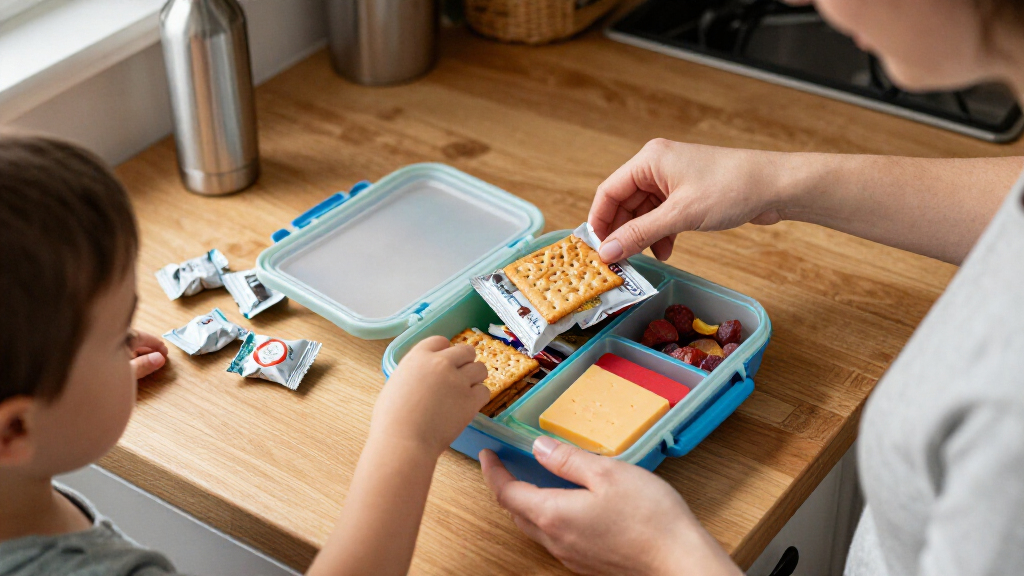
For fullness, Kaiden recommends pairing a carbohydrate-rich snack with protein and healthy fat. For a substantial afternoon snack, she suggests roughly 5 to 10 grams of protein and at least 3 grams of fiber, depending on a child’s age, appetite and activity. The amounts can come from the overall snack or combination of foods, rather than from one packaged item. The article’s product picks include chips and crackers from brands such as Siete, Boulder Canyon, José Andrés Extra Virgin Olive Oil Potato Chips, Top Seedz, Simple Mills, Firehook and Mary’s Gone Crackers.
How to Compare Lunchbox Snacks
The guide addresses a common shopping problem: front-of-package claims can sound more informative than they are. “Made with real fruit,” for instance, does not specify how much fruit a product contains, according to Kaiden. Manaker says a “good source of fiber” claim has a defined meaning—10% to 19% of the daily value per serving—but does not tell shoppers everything about the food.
That distinction can help parents choose snacks based on a child’s needs instead of relying on a label’s promotional language. A gluten-free claim matters for children with celiac disease or gluten sensitivity, Manaker says, but does not provide a nutritional benefit for everyone else. The report’s broader point is to read the complete label and consider the product as a whole.
Kaiden also says she checks formulations even for brands she buys regularly, since recipes can change. Her approach is not to reject a product because of one ingredient: she says she still buys some Simple Mills crackers made with sunflower oil, considering the full product and its almond-flour base.
Products Worth Considering

Graco Modes Nest 3-in-1 Travel System with SnugRide 35 Lite Elite Infant Car Seat, Sullivan

Graco Magnum Project Painter Plus Paint Sprayer

LEGO Icons Tranquil Garden Building Set (10315)
As an affiliate, we earn on qualifying purchases.
The Dietitians’ Label-Reading Advice
The report says Kaiden looks for simple ingredients and generally avoids hydrogenated and partially hydrogenated oils; it also lists high-fructose corn syrup among ingredients she passes on. On oils, she prefers extra-virgin olive or avocado oil when comparable products are available, citing processing differences. She does not claim that all seed oils are harmful or that hexane extraction means unsafe amounts remain in food.
Manaker and Kaiden also point to sources of fiber that can fit into lunches, including fruit, vegetables, beans and whole grains. Nuts and seeds may be options where school rules allow. The report notes that many U.S. children do not reach recommended fiber amounts, but it does not give a product-by-product fiber comparison for all 22 snacks in the supplied material.
The guidance frames nutrition as a matter of the whole snack and the child’s circumstances. Kaiden’s suggested protein and fiber amounts for an afternoon snack are not presented as requirements for every child or every lunchbox item.
“That matters to me more than anything else.”
— Robin Barrie Kaiden, registered dietitian
What the Snack List Does Not Show
The supplied report material does not include the complete set of 22 products or the full list of Lauren Manaker’s picks, so the specific recommendations cannot all be independently summarized here. It also does not provide nutrition-label values, serving sizes or a side-by-side comparison for every snack.
Product formulations can change, and the report does not establish that every listed snack will suit every child’s dietary needs, allergies, school rules or appetite. Its nutrition suggestions are attributed guidance, not a universal prescription. Parents still need to check the current package label and ingredient list.
Check Labels Before Packing
The report’s immediate recommendation is to use its label-reading approach when shopping: check ingredients, added sugars, protein and fiber, then consider how a packaged item fits with the rest of a child’s snack or meal. Kaiden advises revisiting labels even on familiar products because manufacturers may change recipes.
For any of the named products, the next step is to confirm the current ingredients and nutrition facts on the package rather than relying only on a past review or a front-label claim. The supplied material does not announce a follow-up date or a further update to the guide.
Key Questions
What is the news about the 22 lunchbox snacks?
Motherly updated its guide on Nov. 6, 2026, presenting packaged snack picks and label-reading advice from registered dietitians Robin Barrie Kaiden and Lauren Manaker.
What should parents check first on a snack label?
Kaiden says she starts with the ingredient list. Ingredients are listed by weight, so the first items make up the largest share of the product. The dietitians also recommend checking added sugar, protein and fiber.
How much protein and fiber does the report suggest?
For a substantial afternoon snack, Kaiden suggests about 5 to 10 grams of protein and at least 3 grams of fiber, depending on the child’s age, appetite and activity. These amounts can come from the combined snack, not necessarily one packaged food.
Does a gluten-free label make a snack healthier?
Not automatically. Manaker says the claim is relevant for children with celiac disease or gluten sensitivity, but does not offer a nutritional benefit to everyone else.
Should parents avoid every product containing seed oil?
No. Kaiden says she may choose olive or avocado oil when a comparable option is available, but she does not say all seed oils are harmful. She advises considering the whole product rather than making a decision based on one ingredient alone.
Source: mother.ly