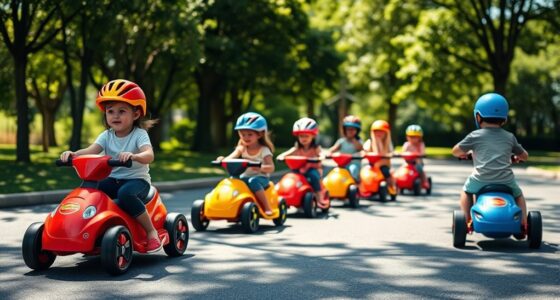
Combining ride-on toys with Montessori language activities offers a fun way to boost motor skills and vocabulary. You can create obstacle courses that encourage your child to navigate while naming objects around them, like “tree” or “car.” Incorporate commands such as “turn left” or “go fast” to reinforce direction words. Using movement paired with language encourages hands-on learning and keeps your child engaged. Keep exploring these ideas to discover even more ways to support their development.

Turn the school run and nap time into listening time
- Thousands of audiobooks, podcasts and originals
- Listen on your phone, tablet or Echo — also offline
- Cancel anytime
Key Takeaways
- Use ride-on toys to create obstacle courses that incorporate vocabulary words like “stop,” “go,” “left,” and “right” for active learning.
- Narrate movements and surroundings during ride-on play to reinforce language in context, such as “turning left at the tree.”
- Set up themed play stations with landmarks to encourage naming, describing, and sequencing activities related to the environment.
- Incorporate turn-taking and direction-giving with peers or family to develop social, conversational, and listening skills.
- Combine physical movement with targeted vocabulary practice to foster holistic growth in language, motor skills, and cognitive development.
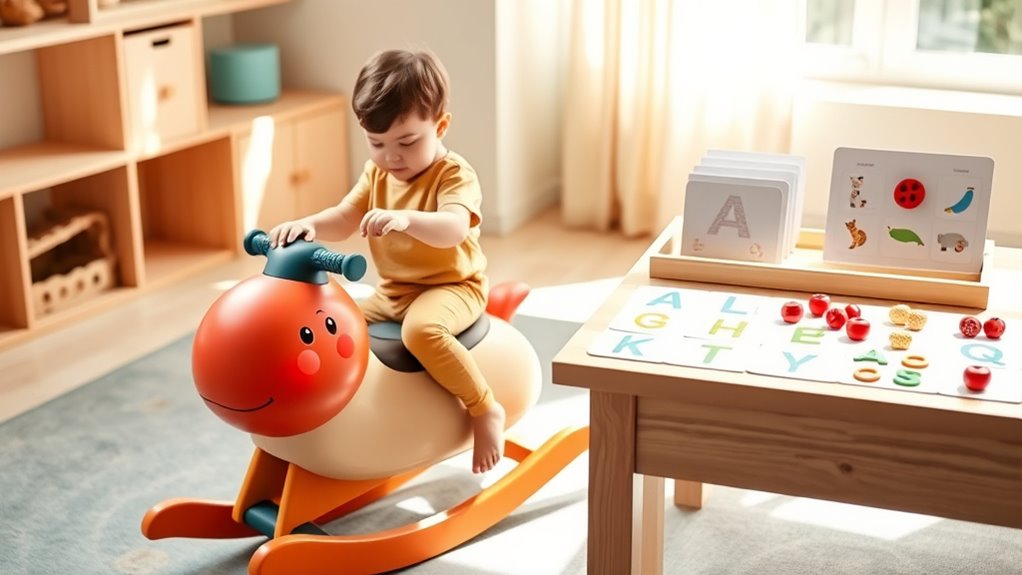
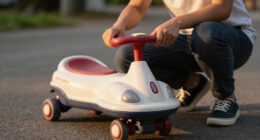
Have you ever wondered how ride-on toys can support a child’s language development within a Montessori-inspired environment? These engaging tools do more than just promote physical activity; they can also be powerful catalysts for enhancing motor skill development and expanding vocabulary. When children push off, steer, and stop their ride-on vehicles, they refine their coordination, balance, and spatial awareness. These motor skills are fundamental, laying the groundwork for more complex tasks later on. As your child navigates around obstacles or follows designated routes, they gain confidence in their physical abilities, which encourages further exploration and learning.
Ride-on toys boost motor skills and confidence while supporting language development in a playful, Montessori-inspired environment.
But the benefits extend beyond just physical growth. Incorporating ride-on toys into language activities offers a natural, playful way to build vocabulary. For example, you can introduce simple words like “stop,” “go,” “left,” “right,” “fast,” and “slow” during play. As your child practices these commands, they begin to associate words with actions and directions, reinforcing their understanding through physical experience. You might also describe the environment around them—”tree,” “building,” “car,” “flower”—prompting your child to observe and recall these words as they move. This integration of movement and language helps solidify vocabulary in a meaningful context, making learning both engaging and memorable.
Creating a language-rich environment with ride-on toys can involve setting up stations where your child can practice naming objects or describing their journey. For instance, you could set up a small obstacle course with different landmarks, encouraging your child to narrate their progress. They might say, “I am turning left at the tree,” or “I am going fast past the house.” This active narration not only improves their speaking skills but also encourages critical thinking and sequencing. Using real-world scenarios during play provides context that makes new words more relevant and easier to remember.
Additionally, you can foster social language skills by involving peers or family members in ride-on activities. Playing together, taking turns, and giving directions promote conversational skills, listening, and understanding others’ speech. This collaborative approach aligns with Montessori principles, emphasizing respect and independence while supporting language development. Moreover, integrating concepts from the Jet Boat design, such as directions and movement, can make these activities even more dynamic and engaging. Overall, combining ride-on toys with intentional language activities creates a dynamic environment where physical activity and vocabulary growth go hand in hand. It’s a fun, practical way to nurture your child’s holistic development while keeping them active, engaged, and enthusiastic to learn new words.
ride-on toy obstacle course for kids
As an affiliate, we earn on qualifying purchases.
As an affiliate, we earn on qualifying purchases.
Frequently Asked Questions
How Can Ride-On Toys Enhance Language Development?
Ride-on toys boost language development by encouraging active play and interaction. As you guide your child during musical storytelling, they learn new vocabulary and understand story concepts better. Moving around on the toy helps them connect words to actions, making language concepts more memorable. You can also introduce descriptive words and encourage your child to express themselves, strengthening their vocabulary building skills in a fun, engaging way.
Are Certain Ride-On Toys More Effective for Language Activities?
Imagine your child zooming around on a colorful ride-on toy, their motor skills thriving with each push and turn. Certain ride-on toys, like those with interactive buttons or themed designs, are more effective for language activities because they spark imaginative play. These toys encourage your child to describe actions, objects, and scenarios, enriching their vocabulary and communication skills while they build motor skills and engage in creative storytelling.
What Safety Considerations Are There When Combining These Activities?
When combining these activities, make certain you supervise your child closely to prevent accidents. Check that ride-on toys are sturdy and durable enough to handle active play, reducing the risk of breakage or injury. Always inspect toys for any loose parts or sharp edges, and keep the play area safe and clutter-free. Your supervision, along with choosing durable toys, helps create a safe environment for engaging language activities.
How Can Parents Integrate Language Games With Ride-On Play?
Think of ride-on toys as a moving stage for your child’s imagination. You can integrate language games by encouraging playful storytelling during play, where they describe their actions or surroundings. Incorporate vocabulary games by naming objects they see or use, turning every ride into a chance to learn. This active engagement keeps your child excited, making language development fun and natural while they enjoy their ride.
What Age Is Best for Combining Ride-On Toys and Language Learning?
You can start combining ride-on toys with language learning around ages 1 to 3, when children are developing gross motor skills and enjoy sensory exploration. At this stage, they can ride, push, and maneuver, which helps build coordination. You can introduce simple words, sounds, and descriptions during play, making language activities engaging and natural. This early combination fosters both physical development and language skills seamlessly.
Conclusion
By blending ride-on toys with Montessori language activities, you create a world where learning and play dance together seamlessly. This approach turns every ride into a journey of discovery, transforming simple movement into rich language experiences. Just as a key open s a door, these activities open your child’s potential, fueling their curiosity and love for learning. Embrace this magical fusion, and watch your child’s development flourish like a garden in full bloom.
Fall Picks
fall essentials
As an affiliate, we earn on qualifying purchases.