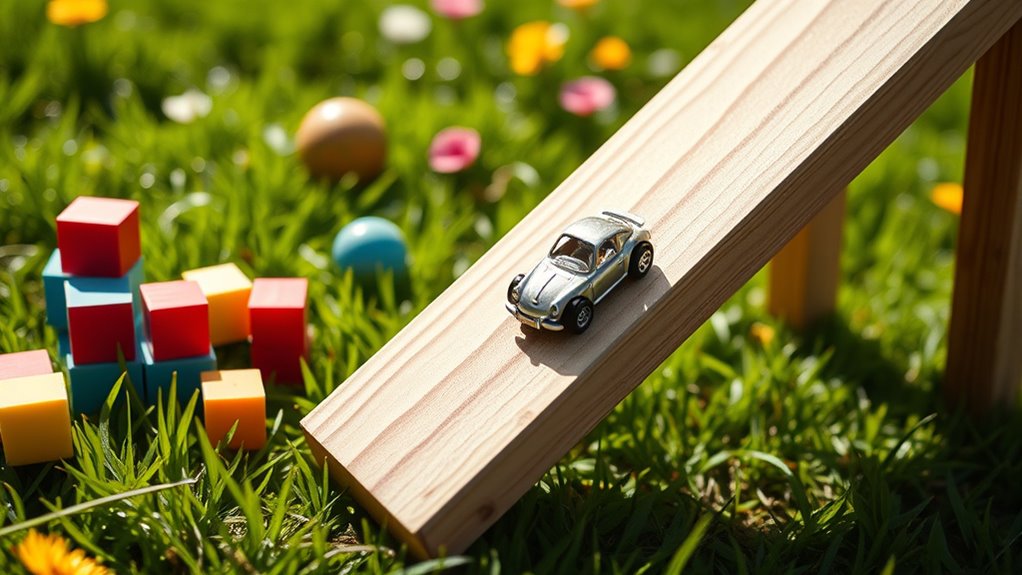

Exploring gravity and motion with slopes and ramps shows how forces affect movement. When you roll objects down a slope, gravity pulls them downward, converting potential energy into kinetic energy. The slope’s steepness impacts how fast objects accelerate, while surface smoothness influences friction, slowing things down. Friction resists motion and causes energy loss, affecting how objects move. If you want to understand how energy, forces, and friction work together, keep exploring these simple demonstrations.
Listen free for 30 days with Audible
Thousands of audiobooks and originals — cancel anytime.
As an affiliate, we earn on qualifying purchases.
Key Takeaways
- Slopes and ramps demonstrate gravity’s effect on objects, influencing acceleration and speed based on steepness and surface smoothness.
- Friction between surfaces resists motion, affecting how smoothly objects slide and converting some energy into heat.
- Elevating objects stores potential energy, which converts to kinetic energy during descent, illustrating energy transformation principles.
- Steeper slopes increase gravitational force components, leading to faster acceleration and higher speeds at the bottom.
- Surface conditions impact energy transfer efficiency, highlighting how friction and surface smoothness influence motion and energy conservation.
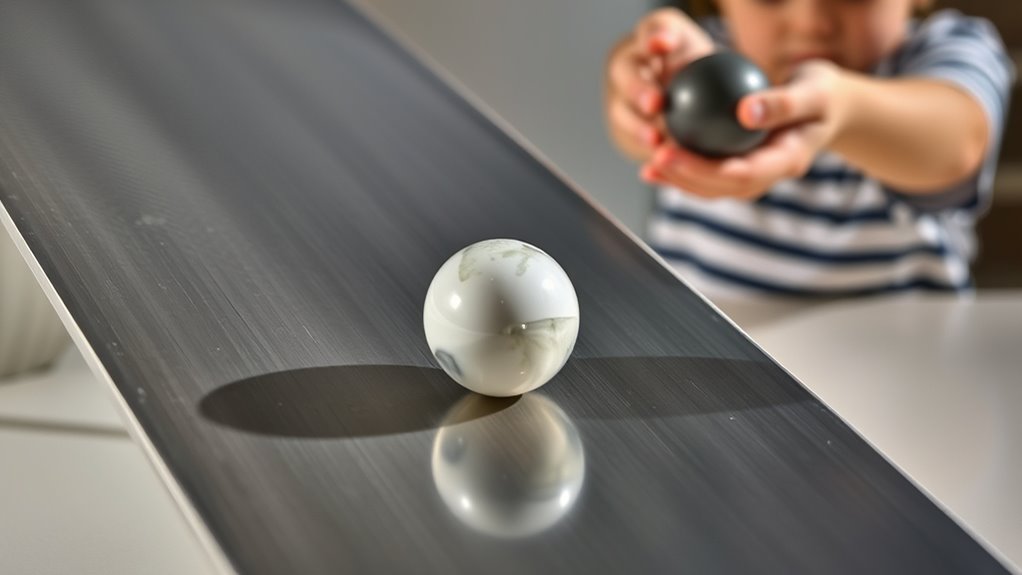
Have you ever wondered what causes objects to fall or why planets orbit the sun? These questions lead us to the fascinating concepts of gravity and motion. When you look at slopes and ramps, you’re seeing simple yet powerful demonstrations of these forces in action. As you set an object on a ramp, friction effects come into play, influencing how smoothly it moves. Friction acts as a resistive force, slowing the object down and converting some of its energy into heat. But beyond friction, there’s a key idea: potential energy. When you elevate an object on a slope, you’re giving it stored energy based on its height relative to the ground. This potential energy depends on the object’s weight and its position on the ramp. The higher the object, the more potential energy it has, ready to be transformed into kinetic energy as it slides down.
When the object begins to move, gravity pulls it downward, converting the stored potential energy into motion. The steeper the slope, the greater the component of gravity acting along the surface, which accelerates the object faster. However, friction effects can dampen this acceleration, making the movement less swift. If the ramp is very smooth, minimal friction allows for a more efficient transfer of potential energy into kinetic energy, causing the object to pick up speed quickly. Conversely, rougher surfaces increase friction, reducing the object’s acceleration and the overall speed at the bottom of the ramp. Watching this process reveals how energy transforms and how forces work together to influence motion.
Understanding potential energy on slopes helps you grasp why objects gain speed as they descend. It also explains why, when you push a box up a ramp, you need to do more work against gravity and friction to lift it higher. The work you do adds to the potential energy stored in the object. When you let go, gravity pulls it downward, converting this stored energy into kinetic energy, which increases as the object accelerates downhill. Friction effects, however, cause some of this energy to dissipate as heat, meaning not all potential energy becomes kinetic. This interplay shows how energy conservation still holds, but some energy always gets lost due to friction. Additionally, understanding the role of potential energy helps explain how energy is conserved and transformed during motion.
As an affiliate, we earn on qualifying purchases.
Frequently Asked Questions
How Does Friction Affect Objects on Slopes?
Friction affects objects on slopes by opposing their motion, and the amount depends on the friction coefficient and surface roughness. When the surface is rougher, the friction coefficient increases, making it harder for you to slide or roll objects down the slope. Conversely, smoother surfaces lower the friction coefficient, allowing objects to move more easily. So, friction plays a key role in how objects accelerate or slow down on slopes.
Can Gravity Change Depending on Location?
Did you know that gravity can vary by about 0.5% across Earth’s surface? Yes, gravity does change depending on location due to gravitational variations and planetary gravity differences. These variations happen because of factors like Earth’s shape, density, and altitude. So, when you move from the equator to the poles, you’ll experience slight differences in gravity, making planetary gravity not the same everywhere on Earth.
What Materials Are Best for Constructing Ramps?
You should choose materials like wood, metal, or durable plastic for constructing ramps, as they offer good material selection and structural stability. Wood is easy to work with and cost-effective, while metal provides strength and durability for heavier loads. Plastic is lightweight and weather-resistant, making it suitable for outdoor use. Prioritize these materials to guarantee your ramp remains stable and safe during use.
How Do Incline Angle and Height Influence Speed?
You’ll notice that increasing the incline angle and height makes objects accelerate faster on frictionless surfaces, boosting their speed. As you go higher, more gravitational potential energy converts into kinetic energy, increasing velocity. The steeper the slope, the less energy is lost to friction, so objects maintain their speed better. This illustrates energy conservation, where height and angle directly influence how quickly objects move downhill, emphasizing gravity’s role in motion.
Are There Real-World Applications of Gravity and Motion Principles?
Gravity guides global gadgets like space stations and planetary orbits, offering essential applications. You see, engineers utilize gravity’s grip to stabilize satellites, keep space stations spinning smoothly, and calculate planetary paths. These principles help you understand how objects orbit, land, and launch across the cosmos. From rocket rides to robotic rovers, gravity’s guiding hand makes modern marvels possible, demonstrating how fundamental forces fuel your fascination with the universe’s endless expanse.
Conclusion
As you navigate the slopes and ramps, think of yourself as a tiny explorer charting a vast, rolling landscape. Each incline is a gentle hill, guiding your journey through gravity’s quiet pull. With every roll and slide, you become a traveler discovering the secrets of motion hidden in nature’s playground. Just like a leaf drifting down a stream, you learn how gravity shapes everything around you, turning simple slopes into lessons of endless wonder.
NFL season / tailgating Picks
team gear
As an affiliate, we earn on qualifying purchases.