Engaging children in math games on wheels like counting laps or spotting patterns makes learning fun and active during travel. You can challenge them to track laps around parks or parking lots, counting in sequences or skip patterns, turning a routine trip into an educational adventure. Point out environmental patterns like stripes or tree sequences to boost observation skills. Keep exploring these ideas to discover more ways to make math both exciting and practical on the go.
Key Takeaways
- Use lap counting to reinforce basic addition and encourage goal-setting during travel or outdoor activities.
- Incorporate skip counting by twos, fives, or tens to challenge and develop advanced number skills.
- Identify and extend environmental patterns like stripes or sequences to boost pattern recognition.
- Create pattern activities with objects or rhythms to develop prediction and critical thinking skills.
- Use visual cues and environmental clues to make pattern recognition engaging and educational on the go.
Math games on wheels make learning fun and engaging, especially when you’re on the go. Whether you’re riding in the car, waiting at a rest stop, or just looking for ways to keep your kids entertained during travel, incorporating math into your journey can turn a dull trip into an educational adventure. One simple yet effective approach is to focus on counting laps and recognizing patterns, which helps build foundational math skills while keeping everyone involved.
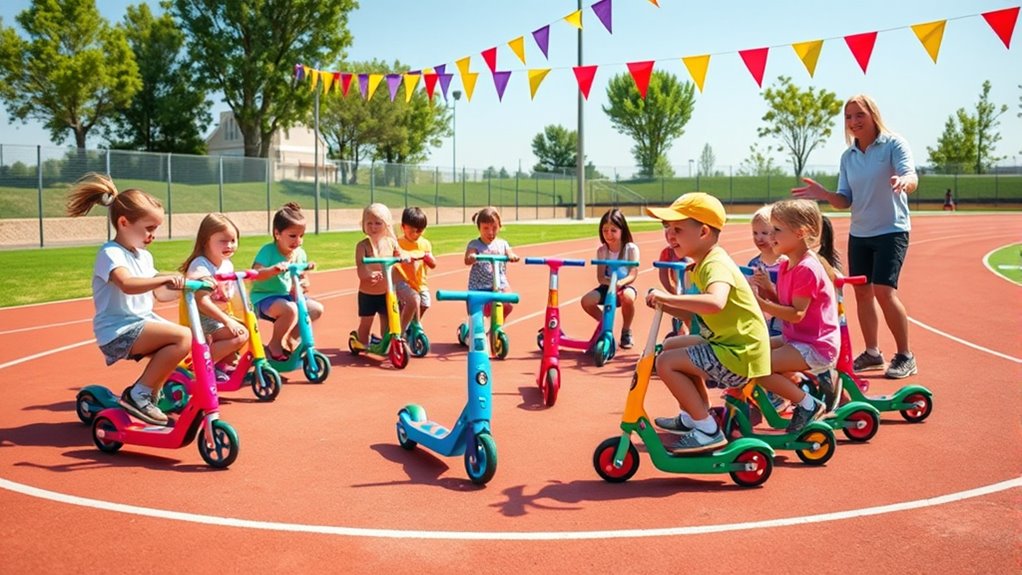
Start by encouraging your kids to count the number of laps they complete around a designated area, such as a park or a parking lot. As they roll along on their bikes, scooters, or even on foot, challenge them to keep track of how many laps they’ve finished. You can make it more interactive by asking questions like, “How many laps have you done so far?” or “What will your total be after two more laps?” This not only reinforces counting skills but also introduces basic addition concepts. You can also turn it into a game by setting goals, like reaching 10 laps, and cheering them on as they approach the target. To add variety, introduce skip counting—have them count by twos, fives, or tens—making the activity more challenging and engaging.
Patterns are another exciting element you can introduce during these outings. As your child rides or walks, point out repeating patterns in their environment, such as the stripes on a zebra crossing, the sequence of trees along the path, or the colors of houses. You can also create your own patterns with objects you find—like arranging rocks, leaves, or toy cars—and ask your child to identify or extend them. For example, if you see red, blue, red, blue, ask, “What comes next?” This encourages pattern recognition, critical thinking, and prediction skills. You can also make it into a rhythmic activity by clapping or tapping in patterns, prompting your child to mimic or continue the sequence. Incorporating visual organization can help children better understand and follow these patterns, making the activity both fun and educational.
As an affiliate, we earn on qualifying purchases.
Frequently Asked Questions
How Can Parents Encourage Kids to Enjoy Math on Wheels?
You can encourage kids to enjoy math on wheels by making it fun and interactive. Play games that involve counting laps, recognizing patterns, or solving simple puzzles during rides. Praise their efforts and celebrate their progress to boost confidence. Incorporate stories or themes they love to make activities engaging. Keep sessions short and varied to maintain their interest, and always show enthusiasm to inspire their curiosity for math.
Are There Age-Appropriate Math Games for Preschoolers?
Yes, there are age-appropriate math games for preschoolers. You can use simple puzzles, counting games, or sorting activities to make math fun. Incorporate everyday objects like toys or snacks to teach numbers and patterns naturally. Keep activities short and engaging, using colorful visuals and hands-on tasks. By making math playful and interactive, you help your preschooler develop early math skills while having a great time.
What Safety Tips Are Recommended for Children Playing on Wheels?
You should always supervise children on wheels like a hawk watching its prey. Make sure they wear helmets, knee and elbow pads for protection, and check that the equipment is in good condition. Teach them to stay in safe areas away from traffic and obstacles. Keep the riding area clear of hazards, and set clear rules to help them stay safe while having fun. Safety first keeps the good times rolling!
Can Math Games on Wheels Improve Classroom Engagement?
Yes, math games on wheels can boost your classroom engagement by making learning interactive and fun. You’ll notice students become more enthusiastic as they participate actively, improving their understanding of math concepts. These games encourage collaboration, critical thinking, and problem-solving, keeping students motivated. Incorporating movement into lessons also helps break up routine, making learning more dynamic and memorable for everyone involved.
How Do Math Games on Wheels Support Different Learning Styles?
Math games on wheels support different learning styles by offering hands-on activities for kinesthetic learners, visual aids for spatial thinkers, and spoken instructions for auditory students. You can engage all students by incorporating movement, visuals, and discussion, making math more accessible and fun. This flexibility helps each learner connect with the material in a way that suits them best, boosting confidence and understanding across diverse classrooms.
Conclusion
As you hop onto these math games on wheels, you’re steering through a fun-filled journey of learning. Just like a cyclist pedaling up a hill, every turn and lap builds your confidence and skills. These games turn math into an adventure, making it feel like you’re maneuvering a lively, colorful racetrack. So, keep riding, keep exploring, and let the wheels of learning turn smoothly on this exciting math ride!