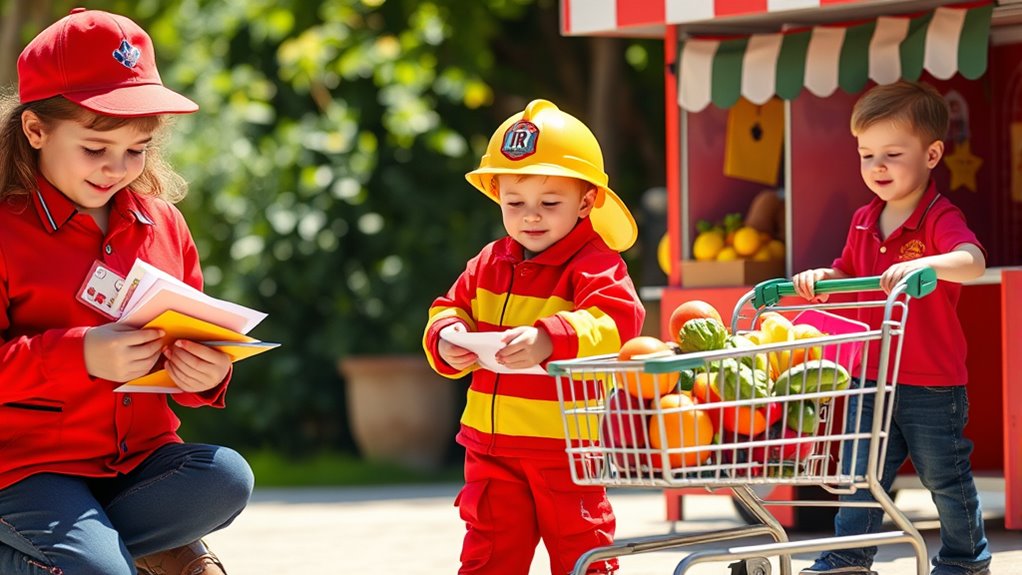

You can easily enjoy role play on the go by using everyday household items to recreate a post office, firehouse, or market. With just paper, boxes, toy money, or costumes, you can encourage your kids to act out real-world roles, boosting creativity, social skills, and teamwork. These games are simple to set up anywhere—at home, in the park, or during breaks. Keep exploring how to make these imaginative adventures even more fun and engaging.
Key Takeaways
- These role-playing games are portable and require minimal setup, making them perfect for play during travel or outdoor outings.
- Use household items like boxes, toys, and pretend money to create realistic post office, firehouse, and market environments.
- Encourage imaginative scenarios such as delivering mail, responding to emergencies, or shopping to develop social and problem-solving skills.
- Engage children in physical activity and teamwork through role-specific tasks like extinguishing fires or organizing shipments.
- These activities foster creativity, communication, and organizational skills while being adaptable for spontaneous play anywhere.

Have you ever wanted to practice your role-playing skills anytime and anywhere? With the right imagination and a few simple props, you can turn any space into a lively post office, a bustling firehouse, or a busy market. These games are perfect for spontaneous play sessions, helping you develop social skills, problem-solving abilities, and creativity without needing elaborate setups. The best part? You can do them wherever you are—at home, in the park, or even during a quick break at school or work.
Imagine transforming your living room into a post office. You can use empty boxes, envelopes, and stamps to create mailing stations. As the postal worker, you’ll sort mail, check addresses, and deliver packages to your friends or family members playing the customers. This activity encourages organization and attention to detail. If you’re the customer, you get to practice describing what you want, giving clear instructions, and waiting patiently. It’s a fun way to learn about communication and customer service, all while pretending to handle real-life tasks. Plus, you can add a twist by creating special delivery missions, like delivering a secret message or a gift to a specific person. This keeps the game exciting and makes the role feel more meaningful.
Transform your living room into a post office with fun mail sorting and delivery missions to boost organization and communication skills.
Switching gears to the firehouse game, you can set up a scenario where someone is the firefighter, and others are the team helping to respond to emergencies. Use a few chairs or cushions to build a “fire station,” and designate a corner as the fire scene. When you hear the call for help, you race to gather your “gear”—perhaps hats, towels, or even toy hoses—and rush to extinguish the imaginary blaze. This game teaches quick thinking, teamwork, and the importance of helping others. It also sparks physical activity and encourages you to think creatively about how to handle emergencies. You can introduce new challenges, like rescuing a stuffed animal or saving a “victim” from a pretend fire. Playing firehouse on the go makes you feel like a hero, boosting confidence and empathy.
Finally, the market game transforms your space into a lively shopping environment. Use toys, pretend money, and household items as goods for sale. You can take turns being the shopkeeper or the shopper, practicing bargaining, counting money, and making choices. This game improves math skills, social interaction, and decision-making. It’s a flexible game that can be as simple or elaborate as you want, and it’s perfect for quick play sessions. Whether you’re buying imaginary fruits and vegetables or selling handmade crafts, you’re engaging in meaningful role-play that enhances communication and understanding of commerce. Playing these role games on the go is a fantastic way to boost your imagination and social skills without ever needing a formal setup. All it takes is a bit of creativity, some household items, and your willingness to jump into different roles anytime the mood strikes. Additionally, observing real couples navigating life together can inspire themes of teamwork and cooperation during play, enriching the role-playing experience.
pretend play mail sorting set
As an affiliate, we earn on qualifying purchases.
As an affiliate, we earn on qualifying purchases.
Frequently Asked Questions
What Age Range Is Best Suited for These Role Play Games?
You’ll find these role play games best suited for kids aged 3 to 8 years old. At this age, children love pretending and exploring different jobs and scenarios, which helps develop their social, emotional, and cognitive skills. Younger children enjoy the imaginative aspect, while older kids can engage more deeply with role-playing. These games are perfect for encouraging creativity, teamwork, and problem-solving during playtime.
Are There Recommended Safety Precautions During Active Role Play?
You should supervise your children closely during active role play to guarantee safety. Set clear boundaries so they don’t wander into unsafe areas, and encourage gentle play to prevent injuries. Remind them to handle toys and props carefully, and avoid small parts that could be choking hazards. Keep a first aid kit nearby, and stay alert for any signs of discomfort or accidents. Your supervision helps make the play both fun and safe.
How Can I Customize the Games for Different Skill Levels?
Think of tailoring these games as planting seeds in a garden—adjusting the soil to nurture growth at each child’s pace. You can modify complexity by simplifying tasks or adding challenges, like a gentle breeze encouraging confidence. Use visual aids, role prompts, or timers to match different skill levels, ensuring each child feels like the hero of their own story. This creates a vibrant, inclusive space where everyone can flourish at their unique rhythm.
What Materials or Props Are Needed to Enhance the Experience?
You’ll want to gather simple materials like pretend money, clipboards, and paper for the post office; toy hoses, helmets, and fire trucks for the firehouse; and plastic fruits, vegetables, and shopping carts for the market. Using costumes or hats can make the experience more immersive. These props engage kids, spark their imagination, and make role play more realistic and exciting for different skill levels.
Can These Games Be Played Indoors During Bad Weather?
Yes, you can definitely play these games indoors during bad weather. You just need to adapt the space and props to fit the environment. Use household items as pretend supplies, designate specific areas for different roles, and set clear boundaries. This way, you maintain the fun and educational aspects of the games while ensuring safety and comfort inside your home. It’s a great way to keep kids engaged rain or shine.
portable fire station toy kit
As an affiliate, we earn on qualifying purchases.
As an affiliate, we earn on qualifying purchases.
Conclusion
With these role-playing games, you’ll turn any ordinary day into an extraordinary adventure—like having a whole world right at your fingertips! Whether you’re pretending to be a firefighter, a cashier, or a mail carrier, you’ll spark imagination and boost confidence in ways that feel as big as the universe. So grab your pretend tools and jump in—because these games aren’t just fun, they’ll make your imagination soar higher than the tallest skyscraper!
kids role play market stand
As an affiliate, we earn on qualifying purchases.
As an affiliate, we earn on qualifying purchases.